
M. Kat Anderson presents a wealth of information on native land management practices gleaned in part from interviews and correspondence with Native Americans who recall what their grandparents told them about how and when areas were burned, which plants were eaten and which were used for basketry, and how plants were tended. The complex picture that emerges from this and other historical source material dispels the hunter-gatherer stereotype long perpetuated in anthropological and historical literature. We come to see California’s indigenous people as active agents of environmental change and stewardship. Tending the Wild persuasively argues that this traditional ecological knowledge is essential if we are to successfully meet the challenge of living sustainably.”
]]>Perhaps we need to shift our perspective. (I’m gently referring to everyone with that we, myself included. For example, how comfy were people sitting in rows and listening to lecture after lecture? Ask yourself where you sit on that spectrum. I am realising more and more that I am past left field. You can probably find me digging and planting that field- metaphorically.) – Laura Ritchie
]]>The world is in tumult and ecological, biological and one could argue social overshoot is upon us — but we still have wild places. Places where the Brown Bear hunts and rests, places where the Loon nests, places where the Sockeye run, places where the the Whip-Poor-Will still enchants and catches souls, where the wolf runs free, where the wolverine and lynx hunt unabated.
My thanks go out to every human who has fought to conserve and preserve our global wild lands. In the US, Muir and Roosevelt, joined by legions of you; I remember you — dedicated Student Conservation Association Volunteers (now theSCA), rangers, trailcrew, conservation biologists, wanderers, backpackers, philanthropists, companies, presidents.
Never before have our wild lands appeared so “fresh, so joyous, so immortal”.
As Thich Nhat Hanh has written, “the dandelion has your smile”….. I would add that the wild has your core. Please, on this Earthday be aware, act and in everyday live…..live knowing that as John Muir knew: “When we try to pick out anything by itself, we find it hitched to everything else in the Universe.”. Listen to the birds, yes, stop and smell the flowers, backpack a wilderness area, kayak a coast and if you can–contribute to the conservation and preservation of our last wild lands. You have my gratitude, thanks and comraderie.
Words to live by: http://lisa.steelemaley.io/words-to-live-by/
And an easy way to contribute: http://www.patagonia.com/vote-our-planet.html
Happy Earth Day.
]]>
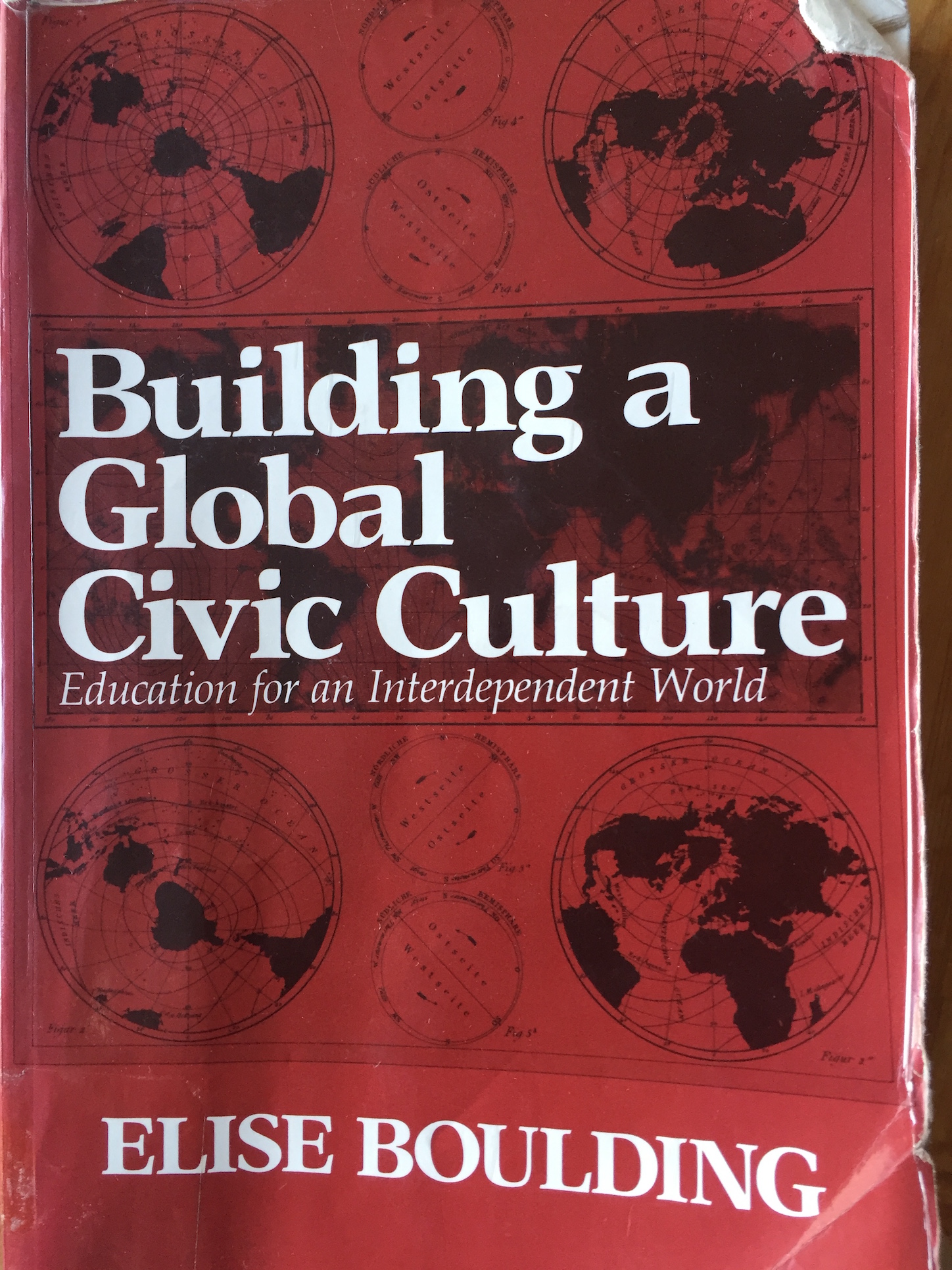
Boulding (1990) Building a Global Civic Culture: Education for an Interdependent World again…..
Imagining how events could be otherwise than they are is a hallmark freedom and power of human beings. Making social imagination work for us involves us in new concepts and principles, in new ways of using our minds to grasp complexities we do not yet comprehend. Thinking this way helps us construct new social realities both locally and globally. Social imagination is not merely for the sake of of academic knowing; it must include our feelings, and it must include our acting.
Hahn (1940) The Love of Enterprise, The Love of Aloneness, The Love of Skill
IF it be true that Education can heal the State, then indeed we educators have a grave and anxious responsibility.
]]>
Increasingly interested in Dave’s work on systems and structures. His erudite thoughts on complex adaptive systems immediately resonate with how humans learn vs how we engineer learning for humans in schools. In this talk he also introduces how his company Cognitive Edge uses what I have called Auto-Ethnography to awake participatory routes to change….I do believe we are headed, in the not so distant future, beyond education, where our self determination and indeed, applied ethnographies of ourselves will blend with cooperation and a new networked learning. In these new ecologies of education, concepts like Dave’s intergenerational fractal engagement will be common and could lead to mutual aid.
Perhaps Piper Hahn will indeed come alive in the actions of young people. And Networked Learning Ecology North America will illuminate a pathway or two.
]]>
Learning in Landscapes of Practice…. resonates because the concept of knowledgeability, or someone’s condition of being knowledgeable is so salient for the success of new directions in education yet so neglected in educational practice. In education, silos for competency are legion and attempts to integrate meaningful professional learning especially participatory professional learning across divisions and for the for organizational change are not common.
Thinking of education in terms of “landscapes of learning” allows for sustained and inclusive innovation. We need to engage every stakeholder in new forms of learning as successful new ventures create meaning and become realistic alternatives to traditional education. And needless to say, there will need to be spaces of permission for radically new types of professional learning, for instance, to understand and critique a whole educational system — a system that exists quite often to perpetuate itself as opposed to the needs of learners and communities.
We need to engage each teacher in co-constructing the change we undertake. Key is supporting teachers in seeing learning and design as part of their critical work — work that will yield results they deeply care about and believe in from theory to praxis. The common refrain in K-12 education that, “we do not have enough time for theory and design, we just need to….”, or, “we will leave that to the experts….we have teachers or kids in front of us….” is irrelevant in a world of unprecedented complexity. These views are at opposition with the reality that education is a social construct, that must be theorized, constructed/reconstructed through design and praxis, and sustained by individuals in the community on a consistent basis.
No educator, parent or policymaker should leave the spaces of education, specifically praxis, unexamined. So where theory can open you to thought, ultimately praxis allows for the experience, knowledge building and networking towards both the boundaries and possibilities of the new direction you are taking. These are critical conversations to have in education and society and we need to take a much closer look at how we are shaping ongoing professional learning and ultimately design in our ventures. Learning in Landscapes of Practice is a book that will peak questions toward these aims — important for all of us working to create resilient pathways for our new directions in our field.
*Wenger (1998) Communities of Practice: Learning, Meaning, and Identity and the foundational work of Lave and Wenger on situational learning (1991) Situated Learning: Legitimate Peripheral Participation. Though these are dense works at times, they are well worth your time. In this space, I would also recommend Lave’s (2011) Apprenticeship in Critical Ethnographic Practice.
**Though my experience is primarily in education, these points are, I hope, important for innovation in any sector.
]]>We have a dearth of prototypes to point to as new directions in education. There are some promising school ventures representing significant and now well-highlighted success stories — and sure there is a raft of new technology flooding the market and a buzz of sorts. These motions are not enough and in the case of technology, likely to reinforce 20th-century practices instead of transform. One of the best keynotes on education I have ever seen, captured here with sketchnotes, is John Seely Brown’s 2012 DML talk. JSB posits “technology is the easy part…the hard part is how to invent new institutional forms, social practices and skills….” He then illuminates the elephant in the room for education, “in 5–10 years, if our schools and university’s look the same as they do now….we’ve got problems”. We are now at 5 years in from the talk.
We need to reimagine education. I know you have heard this before, and I also know that many of you are where you are because of the system I am asking to be reimagined — not a small cultural imprint. Yet we should all be thinking about this daily. Global schooling is becoming ever more ubiquitous and our children, again with the exception of improvements to schools are not moving in new directions.
We are living in a world of unprecedented complexity that will only grow more complex. Our children likely can’t wait for their undergraduate years to start experiencing life through learning — it will need to start happening, now. How will they live in today’s world, a world of “Trillons” as Micky McManus coined, trillions of microchips and connections to be made…. and unbounded complexity? Will they have the dispositions to create and connect in this world?
So perhaps a foray into speculative design over your weekend is in order? Take this video that Microsoft’s Future Vision team created as product design fiction. If we applied this diegetic prototype to our thinking and action towards imagining new directions, schools and/or educational ecologies created to cultivate the necessary dispositions for students to actively learn and live in a world of unprecedented complexity. What questions might we ask ourselves, our communities and if in schools our teams? I have listed a few prompts below and I would love to hear your thoughts, questions and about the new directions you are taking.
What pedagogical/structural changes are necessary for students and teachers to find the opening “school scene” normal for their core learning, every day across the school — interdisciplinary learning, prototyping, connected (to the real world) and networked interaction and research….? (start to m.1:08)
What skillsets and mindsets make this young woman (our children in the near future) successful? What kind of work is she doing and how is it blending with her life? 1:08–2:13)
What kinds of projects will companies be engaged in? How are the featured employers finding employees? What are they looking for? (2:13–3:00)
What does balance in life and work look like for this young woman (our children in the near future)? What skills does she possess to deal with balance and ambiguity? 3:00–4:16
Ultimately, how is she successful? How is she connected? How does she find and define success? (4:39–6:28)….
How will our schools need to mutate to cultivate these new dispositions…..?
]]>for their creations don’t integrate well into museums and art markets. Their skills and toolsets have never been formalized. They lack a canon.
Source: The Tools and the Tribute by Bruce Sterling – Bruce Sterling – Medium
]]>— Excerpt from and excellent article by Sarah Dryden-Peterson in December’s Education Researcher.
There are significant questions in global education ecologies. According to UNESCO “Education is a fundamental human right and essential for the exercise of all other human rights.” It is abhorrent that children displaced by war suffer multiple violations of human rights. Dryden-Peterson is adroitly wading into very complicated waters and I thank her for this. We need to wade carefully and look closely at Global Education and war. As Muir has eloquently written,”When we try to pick out anything by itself, we find it hitched to everything else in the universe.”
Recommended media to continue your research and conversation:
]]>