
Learning in Landscapes of Practice…. resonates because the concept of knowledgeability, or someone’s condition of being knowledgeable is so salient for the success of new directions in education yet so neglected in educational practice. In education, silos for competency are legion and attempts to integrate meaningful professional learning especially participatory professional learning across divisions and for the for organizational change are not common.
Thinking of education in terms of “landscapes of learning” allows for sustained and inclusive innovation. We need to engage every stakeholder in new forms of learning as successful new ventures create meaning and become realistic alternatives to traditional education. And needless to say, there will need to be spaces of permission for radically new types of professional learning, for instance, to understand and critique a whole educational system — a system that exists quite often to perpetuate itself as opposed to the needs of learners and communities.
We need to engage each teacher in co-constructing the change we undertake. Key is supporting teachers in seeing learning and design as part of their critical work — work that will yield results they deeply care about and believe in from theory to praxis. The common refrain in K-12 education that, “we do not have enough time for theory and design, we just need to….”, or, “we will leave that to the experts….we have teachers or kids in front of us….” is irrelevant in a world of unprecedented complexity. These views are at opposition with the reality that education is a social construct, that must be theorized, constructed/reconstructed through design and praxis, and sustained by individuals in the community on a consistent basis.
No educator, parent or policymaker should leave the spaces of education, specifically praxis, unexamined. So where theory can open you to thought, ultimately praxis allows for the experience, knowledge building and networking towards both the boundaries and possibilities of the new direction you are taking. These are critical conversations to have in education and society and we need to take a much closer look at how we are shaping ongoing professional learning and ultimately design in our ventures. Learning in Landscapes of Practice is a book that will peak questions toward these aims — important for all of us working to create resilient pathways for our new directions in our field.
*Wenger (1998) Communities of Practice: Learning, Meaning, and Identity and the foundational work of Lave and Wenger on situational learning (1991) Situated Learning: Legitimate Peripheral Participation. Though these are dense works at times, they are well worth your time. In this space, I would also recommend Lave’s (2011) Apprenticeship in Critical Ethnographic Practice.
**Though my experience is primarily in education, these points are, I hope, important for innovation in any sector.
]]>Opening Remarks KWEC13
Successful pathways of innovation are created when an organization cultivates a landscape of professional learning (see Etiene-Wenger and Lave) inclusive of as many of the people who directly affect the success of that organization. As Peter Theil, founder of Paypal, puts it in his book Zero to One — “once you have convinced a large group of people of a plan to build a different future, the most important strength of an organization is new thinking.”
GEMS World Academy-Chicago, the first North American school from the internationally recognized GEMS Education Group, is moving into its second year with a bold goal — to build a different future for education. One of the core reasons for GEMS’ success in sustaining and scaling educational innovation is its unique professional learning program. The schools is a learning organization and professional learning is embedded into all aspects — from the mission and vision to daily practice in learning environments. This “anytime, anywhere” professional learning takes many forms across the school, and it involves everyone. The results are stunning collaboration, creativity and an atmosphere filled with effective professionals serving the children and families who will change the future.
How does it work?
Summer is the time of professional learning for schools, and at GEMS World Academy, we leverage this time in unique and highly effective ways. New faculty are immersed into a world of systems thinking for innovative curriculum design, prototyping, and practice. Though the innovative curriculum is defined for new faculty, the emphasis is on experiencing first hand what GEMS faculty are expected to do. New faculty learn through doing as they collaboratively plan inquiry-based curricula in the classroom, throughout the building and, perhaps most importantly, on Field Studies.
New faculty soon join veteran faculty, having experienced the world of GEMS education and having added their unique ideas and expertise to the school’s practice. What follows are weeks of participatory professional development led by people across the organization, specialists and thought leaders in the field. Sessions are hands on and strategic:
- Mission and vision Workshops and other norming workshops. These were highly academic and deliberative sessions focusing the organization’s commitment to including everyone in the articulation of the mission and vision of the school.
- Nationally recognized experts in mathematics, reading and writing joined expert faculty leaders to deliver professional learning.
- Faculty collaboratively build their inquiry-based curriculum
- The vast technology ecosystem at GEMS World Academy are illuminated and used to deliver much of the professional learning, thus providing new and innovative ways to collaborate and participate in professional learning while gaining important new skills, creating new contexts for learning, and asking probing questions about the future of education.
- Faculty plan their Field Studies cycles in the city (the “field”) to understand the incredible opportunity and complexity of using the city as a learning laboratory for students.
Leveraging Technology for Ongoing Professional Learning
Sustaining innovation through professional learning is taken seriously at GEMS. Whether in strategic planning or designing an interdisciplinary unit of inquiry, the need for ongoing collaboration, transparency and organization is essential for effective teams. In the spring of 2015, we successfully piloted Basecamp, an online project management software for professional learning and collaboration in interdisciplinary faculty projects. Building on the pilot’s success, we have adopted and launched Basecamp across the school for professional learning, and collaborative planning in 2015-2016. Using Basecamp provides a powerful and intuitive way for our faculty to cultivate strong interdisciplinary teams, identify needs and think in new ways. From an organizational perspective, Basecamp has allowed us to see how we are learning and leading as an organization, the incredible work we are doing on a daily basis, and the arc of new possibilities to manage.
Looking ahead
The GEMS World Academy Faculty Seminar Series is a participatory professional learning endeavor cultivated by the Institute for Research and Innovation. The seminar series perpetuates ongoing growth in our faculty, administration, and school community while also providing an outlet for disseminating the thought leadership of GEMS World Academy to others.
Summer professional learning serves as the “entry event workshops” to the faculty seminar, giving an experiential root to ongoing professional learning. Entering the school year, the faculty seminar is a multi-month program of scholarly and experiential faculty development linking the GEMS World Academy curriculum and practice with theory and design in the field of education and beyond. The faculty seminar promotes the core mission and vision of the school by helping faculty members update their knowledge of developments in specific disciplines and then place that knowledge in the context of the innovative practices so essential to GEMS and beyond. Faculty seminars are intended to excite intense intellectual consideration of research, design and practice in the GEMS World Academy program, the field of education and beyond. Seminar topics are intended to encourage interdisciplinary discussion and inspire new avenues for practice, research, teaching, and collaboration. Collaborations among faculty, staff and outside professionals are vitally important. Each year, certain seminars will be dedicated to furthering thought leadership in the field of education. These public events bring sought-after experts and GEMS faculty together for public panels. GEMS families, community members and others gather for these exclusive events that highlight our globally recognized faculty as thought leaders. The first 2015-2016 faculty seminar is titled Field Studies: Building on A Foundation of Experience.
Thoughts
Building the future of education will take the collective work of everyone involved in a school’s organization. It is not enough to offer pieces of professional learning and support. Instead, we need to cultivate the dispositions of everyone to imagine, understand, use and create the sustained innovations necessary to do something truly different, prescient, and needed in our world. To this end, GEMS World Academy is exploring, experimenting, and cultivating innovation through ongoing professional learning. This post is the first in an ongoing series on professional learning and innovation in the 2015-2016 academic year at GEMS World Academy.
This post is an adapted version of a post I wrote for GEMS World Academy — Chicago. The post will be published at Explore: The GEMS World Academy Blog in the coming week.
]]>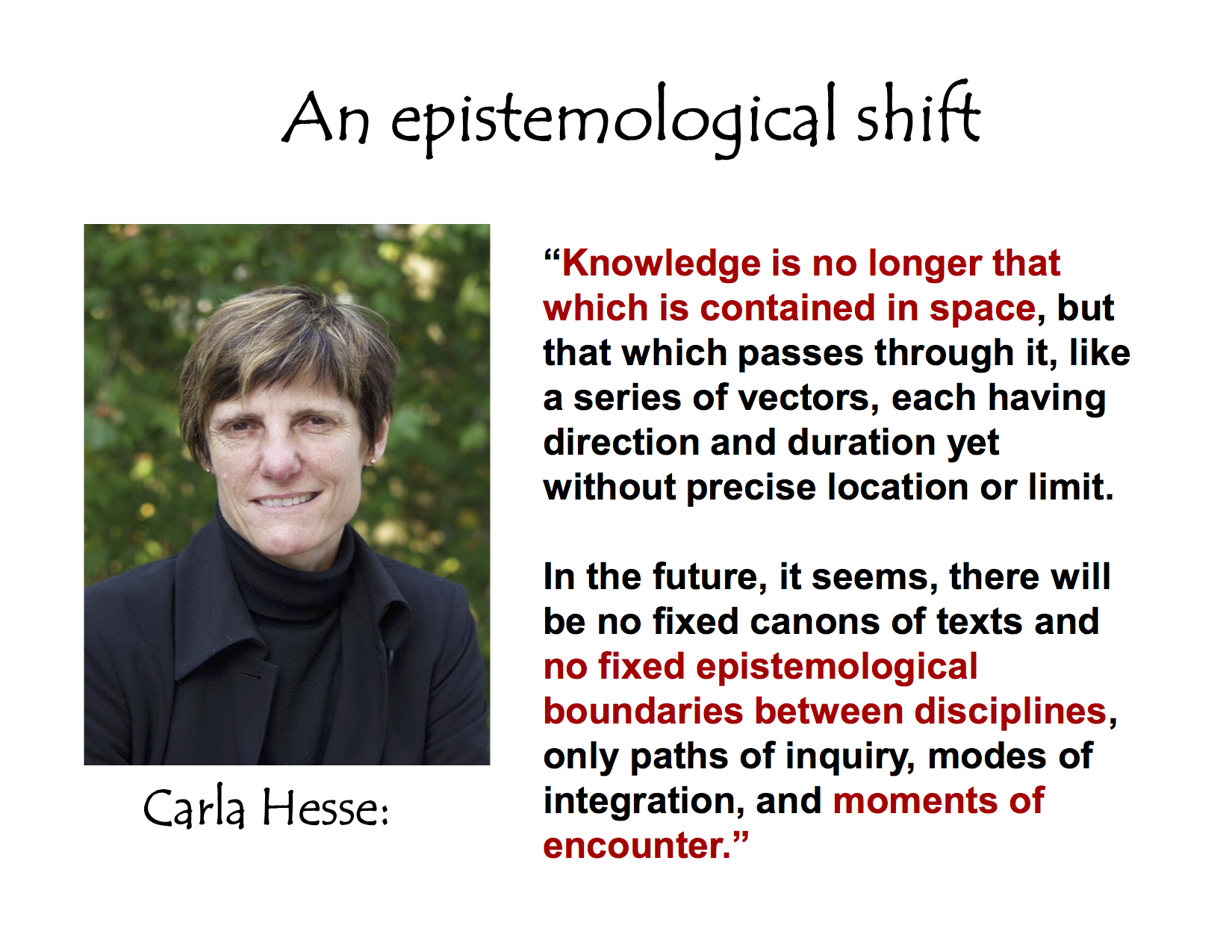
Still captivated by this slide from John Seely Brown. Carla’s adroit projections for the theory of knowledge are so prescient and useful.
]]>Imagining how events could be otherwise than they are is a hallmark freedom and power of human beings
D. Bob Gowin (1988)1
Many educational projects today are trying so very hard and nobly to mutate: to rescue, bypass, reconfigure and support–provide more than a catalyst, cool project or amazing school specific feat. The projects are seeking more, prototyping like mad and gaining grounds in certain spaces–I am wildly impressed by many. My hopes for you, for us, is that we face our dragons. Take a look at Bruce Sterlings NEXT talk from minute 8:58- With a brilliant critical voice, a pin drop hearing claim, and a passionate tenacity he implores a group of the best and the brightest (like you), to look up, look at the system, deeply question–yes keep questioning. Be forewarned, Bruce does not coddle, he offers critical deliberation for a complex world. But my point is not to posit yet another schools and sky’s falling argument. I want you to look up and ask yourself why the copier is still so important, why meetings are still so long, why that schedule is still not working, why the kids–even given control– are still only as good as the control given…. why they are still only engaging in “school”…. do the school and its processes exist for the students future? These, and so much more you see and feel as educators — are your dragons.
Before you undertake another school revision, plan, proposal, design or development please do the following.
In a safe and caring space spend a few hours minimum asking kids what their self and social concerns are. Have them write these concerns on a wall or in an online discussion. Their souls are churning; their adolescence, ever-present, but trust that the world they know, they may not show in school. When the writable surfaces on walls, discussion forums online and all in between (and beyond) are filled with life, pull colleagues with domain knowledge in all of the core subjects together to read and discuss. Agree on how creating projects from the life on those walls/spaces might meet all of your teacher/school objectives.
As elders, guides and yes, teachers you can support young people as they are involved and engaged in an enormous range of knowledge, from information to values clarification, and including content and skills from all disciplines of knowledge–integrated in the context of themes and activities within them. The topics you see written on the walls are organizing centers, significant problems or issues that connect the curriculum to the larger world. These centers serve as a context for unifying knowledge. Knowledge in turn is developed as it is instrumentally applied to exploring the organizing centers; Personal Knowledge: Addressing self concerns and ways of knowing about self; Social Knowledge: addressing social and world issues, from peer to global relationships, and ways of critically examining these; Explanatory Knowledge: content that names, describes, explains, and interprets, including that involved in the disciplines of knowledge as well as commonsense or popular knowledge and Technical/Twenty First Century Knowledge: ways of investigating, communicating, analyzing, and expressing. Finding,Validating, Leveraging, and Synthesizing Information; Communicating, collaboration and problem solving in a technologically rich environment.2
I would love to hear about your experiments and findings.
1.Boulding, E. (1990) Building a Global Civic Culture: Education for an Interdependent World
2. For more in this current of thought see Beane (1997) ‘Curriculum Integration: Designing the Core of Democratic Education’ essential reading.
]]>
 ]]>
Worth another look. I suggest Min 8:50-on as points to consider closely:
]]>
Open Remarks KWEC 13
Curriculum integration
Student Directed Project Based Learning
- create timelines, sequence tasks, protocol for assessment.
- plan for a product to benefit the field of student driven learning
Field Studies
Welcome to KWEC 13
General Reading in the Field of Experiential Education
]]>I was seeing experience and scholastics at confluence.
This and so many more experiences are interwoven in me, I cannot let them go:
- Looking back onto devils pass in the Chugach Range to see a group of high-schoolers walking mountains with the broadest smiles of their lives.
- Years of messy project based learning, driven by kids and their passion– yes– interdisciplinary projects in the social sciences, humanities, maths and beyond.
- Years of Exhibitions of Mastery: Kids defending their passions and work to professionals, the community and world.
- The nervous anticipation of the Georgetown Acceptance Letter that came for a student, who submitted an ePortfolio of mastery for his personalized a co-designed high school.
Don’t let go of what you see that makes your heart fly and soul sing in education. Let it sink in, drive your work, drive your life.
Turn your catalysts into pathways.
]]>
You know when you are amidst something special, when the feeling of that float plane adventure comes back. When I talk and collaborate with my Wife and Charlie Richardson, Shoshana Zuboff, Jake Maxmin, Rob Greco, Grant Lichtman, Bo Adams, Brett Jacobsen and Scott Looney, Shane Krukowski, Jim Groom, Audrey Waters…. I get that feeling of flying out of Davidof Lake again. When I watch Michael Wesch discuss becoming Knowledge-Able vs Knowledgable, I get that feeling again.
What binds us all is a feeling and belief that the educational community to come is not only possible but underway. A belief in the process, driven by a strong understanding of why the field of education needs change, a penchant for designing interventions that will Mutate education, and the ability to iterate as needed to see a pathway to our goals.
Over the coming months, I will write a series of posts on my current project: GEMS World Academy Chicago. As CIO and Director of Academic Technology I am supporting four educational innovations to scale in PK-12 1:
SELF DIRECTED LEARNING
For students to become global citizens they must think and act as self directed learners. From the earliest years we inspire our students to ask more questions than they answer, follow their interests and passions and act as part of a community to identify and work towards solving real world problems. As the years progress our programs support self directed and interdisciplinary/transdisciplinary project based learning which start with student interests and questions about the world. In groups and as individuals students find relevant problems, ask ever more complex questions, work with mixed research methods (both in the city and online), analyze, synthesize and reflect on their work through portfolio’s of understanding and action. Students share their work with the world through service and exhibition.
LANDSCAPE AS LEARNING: A NEW VIEW OF MOBILE LEARNING
For students to become global citizens they must explore, ask questions, observe, empathize and act in the world without borders. During the year a minimum of four hours each week is dedicated to learning outside of the school building in local landscapes. Through a pioneering landscape as learning initiative, students closely engage their local community through field study based mobile learning labs. Through multimedia data collection using iPads and other tools, students experience the sensory aspects of their community while learning about systems, empathizing with others and contributing through engaging projects and meaningful service. This learning in the real world, looks and feels like the real world thus creating the conditions for a fundamental expansion of where and how learning happens. We believe the disposition of seeing and studying the world as it is and working on how it might be otherwise, is at the root of global citizenship, community based learning, internship and entrepreneurial studies.
CONNECTED AND BLENDED LEARNING
For students to become global citizens they need to connect and collaborate across the world in rich and purposeful experiences. Our connected and blended learning program provides a landscape where the internet supports and enhances interactions in real time and anytime. We encourage and support our teachers to engage in a wide array of connected and blended learning with their classes. Our connected and blended learning innovation allows for:
● Co-learning and creation across continents, oceans and cultures giving our students a direct and experiential way of using the internet as a mediating force in learning.
● An extensive digital documentation system allows for self, peer, teacher, parent and community assessment for learning.
● An ePortfolio platform allows students to collect, select, reflect, and project on their learning.
● Networks to connect, aggregate, remix, repurpose and feed forward work and the work of the world.
A SCHOOL AS A HUB OF CONNECTIONS
For students to become global citizens they need a school that promotes self organization, inquiry innovation, and futures thinking. Our physical school has interactive whiteboards throughout the building, on every floor, in hallways and in classrooms along with networked computer stations, hydroponic plant labs, weather stations and much more. At any moment a few students or a whole class can connect with peers or mentors from around the world to discover and learn together in real time throughout the day. Using these tools students also can connect the data from their projects in growing sustainable food systems, tracking weather and climate patterns, or how play effects our learning to a global consortia of other individuals, schools and organizations. Through these interactions students are encouraged to understand how their school functions as part of a global “internet of things”.
In each of these innovations I am struck by the intensity and passion displayed in the praxis of the educators I am working with right now. Their embrace of something very different from any other school has me on edge with excitement and possibility. As I look out from the “floatplane” this time, its not old growth forest and pristine oceanscapes I see, but rather the landscape of three quarters of humanity–the city. What canyon we find to fly, and ocean we decide to traverse, is our to decide. I hope you find the story inspiring.
A [person] who carries a cat by the tail learns something he can learn no other way-Twain
Without question, experiential learning enhances scholastic learning….this type of learning builds confidence, encourages risk taking, reduces the fear of failure, gives oxygen to collaboration, nurtures imagination, promotes problem solving, allows reverie, and grows a taproot from which scholastic learning flowers”.- MacKenzie
1 My acknowledgement to the foundational design and praxis from (Steele-Maley, Richardson, C. 2012) The Bridge Year at Kieve-Wavus, Project Foundry Schools, SuperFlux….et al.
]]>