
Learning in Landscapes of Practice…. resonates because the concept of knowledgeability, or someone’s condition of being knowledgeable is so salient for the success of new directions in education yet so neglected in educational practice. In education, silos for competency are legion and attempts to integrate meaningful professional learning especially participatory professional learning across divisions and for the for organizational change are not common.
Thinking of education in terms of “landscapes of learning” allows for sustained and inclusive innovation. We need to engage every stakeholder in new forms of learning as successful new ventures create meaning and become realistic alternatives to traditional education. And needless to say, there will need to be spaces of permission for radically new types of professional learning, for instance, to understand and critique a whole educational system — a system that exists quite often to perpetuate itself as opposed to the needs of learners and communities.
We need to engage each teacher in co-constructing the change we undertake. Key is supporting teachers in seeing learning and design as part of their critical work — work that will yield results they deeply care about and believe in from theory to praxis. The common refrain in K-12 education that, “we do not have enough time for theory and design, we just need to….”, or, “we will leave that to the experts….we have teachers or kids in front of us….” is irrelevant in a world of unprecedented complexity. These views are at opposition with the reality that education is a social construct, that must be theorized, constructed/reconstructed through design and praxis, and sustained by individuals in the community on a consistent basis.
No educator, parent or policymaker should leave the spaces of education, specifically praxis, unexamined. So where theory can open you to thought, ultimately praxis allows for the experience, knowledge building and networking towards both the boundaries and possibilities of the new direction you are taking. These are critical conversations to have in education and society and we need to take a much closer look at how we are shaping ongoing professional learning and ultimately design in our ventures. Learning in Landscapes of Practice is a book that will peak questions toward these aims — important for all of us working to create resilient pathways for our new directions in our field.
*Wenger (1998) Communities of Practice: Learning, Meaning, and Identity and the foundational work of Lave and Wenger on situational learning (1991) Situated Learning: Legitimate Peripheral Participation. Though these are dense works at times, they are well worth your time. In this space, I would also recommend Lave’s (2011) Apprenticeship in Critical Ethnographic Practice.
**Though my experience is primarily in education, these points are, I hope, important for innovation in any sector.
]]>Opening Remarks KWEC13
We should include futures thinking in schools to help students better anticipate and influence change and to prepare for their future.
Speculative Futures in Education
The topic of futures thinking and specifically the field of Design Fiction (DF) are close to my heart and I realized after commenting on the post mentioned that I had not posted a workshop Speakerdeck from last summer on the topic. The workshop focused on how we might catalyze and provide pathways for change in education through launching speculative futures incubators in schools.
There is much going on in my Speakerdeck with video so will post the full videos from the workshop in full.
Microsoft: Productivity Future Vision
I like this video quite a bit and as an educator it struck me vividly as I can easily see a near future student’s worklife emerging on the screen. As I watched, I continued to ask “what are we doing in schools to cultivate the dispositions she is exhibiting — to deal with her workworld…..” This video is a wonderful example of design fiction — a creation that suspends disbelief in the future narratives we so often hear about for future work worlds for our students in a well crafted story and video. I wrote this about the video for our schools blog:
How should a school in downtown Chicago prepare kids for the future? When Microsoft Research thinks to the near future they see a world where students, researchers, farmers and business people are not only working together but connected across the world through an internet of things (a network of physical objects or “things” embedded with electronics, software, sensors and connected through the internet.)
Although this video is essentially a “design fiction” the story it tells envisions a world to come, based on technologies that are already here. According to Mike Riley, moreInternet of Things Author and Director of Network Administration at GEMS World Academy- Chicago,
“The technologies in this video already exist, just not yet in this form factor. The students here will not only be the young researcher shown in the video someday soon, they will design the systems she is using….”
At GEMS World Academy -Chicago, we know that in a rapidly transforming world, success in further education, employment or society requires individuals to have the ability to see learning everywhere. Today’s students must possess the skills of intuition and have the dispositions necessary to research, design and innovate in mobile and project-based learning experiences. Cultivating these dispositions takes bold, new visionof education and a core belief in what’s possible. Our Students are living our vision of education daily. Whether engaged in an inquiry project that blends music, science and writing, re-mapping the city to make it a better place on a Field Study, or engaged with peers around the world in Connected Learning, we are preparing students now, for the future they will create in the coming years.
Fantasy prototypes and real disruption
The second video clip is a tenacious and as we know true – to – life oration from Bruce Sterling at NEXT13.
https://youtu.be/2VIoRYPZk68
A note from a short post on the talk I wrote outlines a bit of my interest.
Though Sterling situates a role for design fiction in the disruptive innovation/innovators landscape (for a VERY talented crowd at NEXT13 ) he does much more in this talk. His call for a networked civil world is stunning, his scolding questions to the crowd about the facile nature of innovation and humanity even more so.
Interested?
If you are interested in continuing a conversation on DF and education, please do reach out. I would love to hear your thoughts.
More on Design Fiction and Prototyping the Future in another post.
]]>
In 2010, I partnered with former Harvard Business School professor Shoshana Zuboff, her husband, businessman/entrepreneur Jim Maxmin and their son Jake as a student designer to create “GlobalCiv: A New Learning Ecology“. GlobalCiv was a learning partnership between individual learners, mentors, and organizations from around the world. Global Civ was a learning ecology designed to connect driven students across the world:
Sanguine voices are heard on a coastal beach in Maine as a group of high-school age young people gather around multiple mobile devices that are networked via live webcast to their peers in China, New Zealand, London, Uganda and Bolivia in a project called “The Interdependence of Global Water”. This international project based learning pod are gathering, some waking at 1:00am to view sea run Salmon return to spawn on the Penobscot River in Maine, United States. These young people are doing more than watching; they helped make the Penobscot River viable for this process again through their combined research, writing, and service efforts. In partnership with indigenous communities, business interests, academics, local, regional and national governments, and conservation biology organizations they have joined a coalition to remove dams and restore native salmon spawning corridors. There study was intense, memorable and had lasting impact on all involved. As these young people wove service and action into their “core” themes of study: society, environment and economics, there lives were changed, and they helped catalyze a movement for new learning around the world. What we find out is that these young people are collaborating together on similar projects in all of the six world regions mentioned and in concert with each other in a new learning ecology. There are no “walls” in this learning ecology, rather these students learn year round, individually and in groups at regional based learning centers where they come to collaborate, problem solve and socialize with other project based learners. The bulk of the work these brave young people accomplish is done in the field, at home, or traveling in “mobile learning labs” utilizing the most innovative eLearning tools imaginable. The blended eLearning networks used to collaborate on the integrated global projects mentioned, here also leveraged to connect domain territory specialists and mentors to young people as they constructed an understanding of quantitative reasoning, social sciences, literature, experimental sciences, and visual arts in integrated project based learning. The ePortfolios of each learner on that beach in Maine and around the world would be constructed to exhibit learner mastery of knowledge territories and to meet international and national standards in education. This is international learning done across cultural, environmental and economic borders; creating a global frontier for critical education.
Then in 2012, building on the success of GlobalCiv I launched Networked Learning Ecology North America with my wife and a group of dedicated regional entrepreneurs. NLENA sought to weave together a mesh network of young people, parents, educators, and partners in the Midcoast region of Maine and across the world. We were working to realize a new ecology of learning, distributed, connected and scalable:
Piper is a 15 year old who lives in Midcoast Maine, US. A year ago, Piper heard about a new way to learn, and decided to take part in a new learning experience called the Maine Networked Learning Project. Known as “the Mesh” to participants, this learning ecology offered Piper the chance to apply her passion for learning in highly experiential and collaborative ways with groups of young people of varied ages, adult and youth mentors with knowledge territory specialties and organizations focused on ensuring sustainable and resilient societies, economies, and the environment. This is a snapshot of her day.
A day in the learning ecology of Piper Hahn
Piper gets ready for her weePiper Hahn’s Networked Learning Ecology by sitting outside sipping tea and looking at her smart phone. She is checking project updates sent from the team she has been working with for the last two months on her Google Reader and Twitter feed. The project Piper is checking in on deals with food justice in the rural communities of her bioregion.
Seeing many updates, and much activity she decides to look at the overall “mesh” schedule for the day. She notices that the MNLP van will be moving across the local region starting in an hour. To get a ride on this local transportation system she has to ride her bike to a station stop or have her parents drop her off at the regional mesh meet-up location. But before deciding this she reviews her weekly schedule on her mobile.
Piper notices that she and three others will be presenting at the local Veterans of Foreign Wars organization to a large group on the history of local food cultivation in the region. She and her Food Justice project group have spent a good deal of time completing ethnographic studies of the areas “locals”. These participant interviews are seminal to their presentation as they show that local sustainability and resilience projects are not “outside” or “rich Peoples” pursuits, but can save local economies and the historical heritage this stakeholder group cherishes. The group has also been working in restoration crews on local farms as a service learning tie in to their studies. The project has been extensive. Piper and her group have covered mathematics, experimental sciences, writing, social sciences and much more in an integrated project framework. They have relied on their mesh mentors, local experts (educators, authors, historians, scientists….), and the internet for research, recording (writing, video) and exhibiting their knowledge and understanding to multiple community stakeholder groups.
As the project presentation pre-work is done, Piper contacts her group via twitter hashtag to remind all that they will need an hour to meet-up before the presentation and to ride their bikes to the VAW hall from the meet-up. Immediately she gets a response from three of the four other group members that they will meet prior to the VAW event. They remind each other that a collaborative learning session will be going on for applied algebra and trigonometry concepts at Noon. This session will be special, as an innovative regional planner from rural Scotland will be mentoring at the Self Organized Learning Environment today along with their local quantitative reasoning/systems thinking mentors. She video chats with one participant letting her know that she will be at the SOLE, and is hoping to get a ride to her house (or dorm) after today’s VAW presentation. That done, Piper checks with her parents (or dorm parents) and decides to ride her bike to a mesh station stop. She then rides the mesh van into town and catches up on posts in her Reader and replies to myriad comments and responses in her network on the way.
At the Meet-up location (a wide open space that reminds Piper of a open market of some kind), she settles in with the other young people in study, discussion and deliberation. Today she takes out her tablet and reads a work in global literature that was suggested by a mentor she has in South Asia. She will take notes on the work over the next hour and send those notes via blog post to the mentor. The mentor, other participants and Piper are involved in a global project combining cultural understandings of place into a wiki resource for future learners to use. She sees connections everywhere in her learning and after being inspired by an experience in India she’s just read about (or had?), Piper adds content for today’s VFW presentation to the shared presentation document for group review.
Piper takes a run with others from the meet-up, and then decides to review the quantitative reasoning skills that figure into the edible re-vegetation project from Scotland being discussed at the SOLE today. Piper will get another chance to apply her growing knowledge and understanding with today’s SOLE because the re-vegetation work they are doing locally is based on the Scottish project being discussed.
After the SOLE, and successful VAW presentation the group meets at a Mesh group members house. The group has grown from five to seven now as the crew who filmed the presentation and ethnographic methods over the last months are with them to discuss editing and working on the script for the groups public exhibition of findings. Piper and her group know that the scientists, mentors, politicians, local and global participants, and their peers will attend the exhibition. This step in their project leads to funding and further action on their multi-year food security project. After Dinner with the host family, rides home for most, and ePortfolio updates. The rest of the week will be full of networked, experiential, and mobile learning directly applied to creating solutions in an interdependent world.
Then in 2013, I co-designed “The Bridge Year at Kieve-Wavus” again with my wife and long time independent school leader Charlie Richardson. A truly amazing venture, The Bridge Year engaged the Independent School world with a new conversation about what’s possible in education:
The Bridge Year is a year-long, co-educational, learning experience in which students explore their academic core through campus and outdoor projects and field studies which are authentic, integrated, and personalized. Students learn everywhere, have extensive one on one attention and experience life as a daily learning opportunity. The Bridge Year student comes from around the world, the US and Maine representing a wide variety of backgrounds. They are young people seeking transformative experiences that support the growth necessary to unlock their amazing talents, passions, and curiosity for learning and life. At The Bridge Year, students live their learning.
These projects were successes in the own right, test flights for what’s possible. To quote Zuboff and Maxmin on GlobalCiv in 2010 — the project was “at least a decade to soon “. Yet in 2013 after her experience with Global Civ she wrote of The Bridge Year “The Bridge Year fills a major gap in today’s educational landscape. It can provide a gateway to high school that is critical to the long term success and well being of many young people. Student-driven , project- based learning can be a life-changing experience. When this is combined with personal instruction, exposure to digital learning tools, and an active learning community, students can develop the capability for joyous and self-directed learning both in high school and for the rest of their lives.”
There are parts of these projects in all of the work I do and in my current thoughts design and partnerships. That the rise of the micro-school is upon us — interests me all the more. The projects listed above were my attempt to answer myriad questions about a system of schooling that seemed/s to exist for its own sake– as institutions, not ecologies of education as they need to be.
I remain fiercely loyal to the independence” offered by independent schools, and some charters. That more schools are considering or being advised to create autonomous programs (see Horn et al. in independent thinking) intrigues me. That VC are looking for new school designs and prototypes for the future is equally buoying. What if independent schools en mass, were looking in the same way too? Would this be a significant Bypass, and eventually, to use Zuboff’s language, Mutation in education? It certainly will depend on the market forces driving the change — be it test scores or transformed and highly personalized educational ecologies…..
Independent schools will need to embrace these projects with their missions close at heart, their vision alight and not just in fear of loosing market share. I can imagine and would embrace the laboratories of educational ecologies that may emerge. The national and worldwide wonder at a new very visible movement of change in education, and possibly, just possibly systemic change would be welcome.
Feature Image: https://rbkclocalstudies.wordpress.com/tag/notting-hill-adventure-playground/
]]>A few notes (of many) on Valve’s Employee Handbook.
]]>We want innovators, and that means maintaining an environment where they’ll flourish
Never be afraid to run an experiment or to collect more data.
This company is yours to steer—toward opportunities and away from risks. You have the power to green-light projects. You have the power to….
Why does your desk have wheels?
You were hired to constantly be looking around for the most valuable work you could be doing.
Nobody expects you to devote time to every opportunity that comes your way. Instead, we want you to learn how to choose the most important work to do.
Yes. There’s no secret decision-making cabal. No matter what project, you’re already invited. All you have to do is either (1) Start working on it, or (2) Start talking to all the people who you think might be working on it already and find out how to best be valuable. You will be welcomed— there is no approval process or red tape involved. Quite the opposite—it’s your job to insert yourself wherever you think you should be.
Sometimes things around the office can seem a little too good to be true. If you find yourself walking down the hall one morning with a bowl of fresh fruit and Stump- town-roasted espresso, dropping off your laundry to be washed, and heading into one of the massage rooms, don’t freak out. All these things are here for you to actually use. And don’t worry that somebody’s going to judge you for taking advantage of it—relax! And if you stop on the way back from your massage to play darts or work out in the Valve gym or whatever, it’s not a sign that this place is going to come crumbling down like some 1999-era dot-com start- up. If we ever institute caviar-catered lunches, though, then maybe something’s wrong. Definitely panic if there’s caviar.
Over time, we have learned that our collective ability to meet challenges, take advantage of opportunity, and respond to threats is far greater when the responsibility for doing so is distributed as widely as possible. Namely, to every individual at the company.
We all need feedback about our performance—in order to improve, and in order to know we’re not failing. Once a year we all give each other feedback about our work. Outside of these formalized peer reviews, the expectation is that we’ll just pull feedback from those around us when- ever we need to.
You’ve solved the nuts-and-bolts issues. Now you’re moving beyond wanting to just be productive day to day—you’re ready to help shape your future, and Valve’s.
Everyone is a designer. Every- one can question each other’s work.
Would I want this person to be my boss?; Would I learn a significant amount from him or her?; What if this person went to work for our competition?
Valve will be a different company a few years from now because you are going to change it for the better. We can’t wait to see where you take us.
Imagining how events could be otherwise than they are is a hallmark freedom and power of human beings
D. Bob Gowin (1988)1
Many educational projects today are trying so very hard and nobly to mutate: to rescue, bypass, reconfigure and support–provide more than a catalyst, cool project or amazing school specific feat. The projects are seeking more, prototyping like mad and gaining grounds in certain spaces–I am wildly impressed by many. My hopes for you, for us, is that we face our dragons. Take a look at Bruce Sterlings NEXT talk from minute 8:58- With a brilliant critical voice, a pin drop hearing claim, and a passionate tenacity he implores a group of the best and the brightest (like you), to look up, look at the system, deeply question–yes keep questioning. Be forewarned, Bruce does not coddle, he offers critical deliberation for a complex world. But my point is not to posit yet another schools and sky’s falling argument. I want you to look up and ask yourself why the copier is still so important, why meetings are still so long, why that schedule is still not working, why the kids–even given control– are still only as good as the control given…. why they are still only engaging in “school”…. do the school and its processes exist for the students future? These, and so much more you see and feel as educators — are your dragons.
Before you undertake another school revision, plan, proposal, design or development please do the following.
In a safe and caring space spend a few hours minimum asking kids what their self and social concerns are. Have them write these concerns on a wall or in an online discussion. Their souls are churning; their adolescence, ever-present, but trust that the world they know, they may not show in school. When the writable surfaces on walls, discussion forums online and all in between (and beyond) are filled with life, pull colleagues with domain knowledge in all of the core subjects together to read and discuss. Agree on how creating projects from the life on those walls/spaces might meet all of your teacher/school objectives.
As elders, guides and yes, teachers you can support young people as they are involved and engaged in an enormous range of knowledge, from information to values clarification, and including content and skills from all disciplines of knowledge–integrated in the context of themes and activities within them. The topics you see written on the walls are organizing centers, significant problems or issues that connect the curriculum to the larger world. These centers serve as a context for unifying knowledge. Knowledge in turn is developed as it is instrumentally applied to exploring the organizing centers; Personal Knowledge: Addressing self concerns and ways of knowing about self; Social Knowledge: addressing social and world issues, from peer to global relationships, and ways of critically examining these; Explanatory Knowledge: content that names, describes, explains, and interprets, including that involved in the disciplines of knowledge as well as commonsense or popular knowledge and Technical/Twenty First Century Knowledge: ways of investigating, communicating, analyzing, and expressing. Finding,Validating, Leveraging, and Synthesizing Information; Communicating, collaboration and problem solving in a technologically rich environment.2
I would love to hear about your experiments and findings.
1.Boulding, E. (1990) Building a Global Civic Culture: Education for an Interdependent World
2. For more in this current of thought see Beane (1997) ‘Curriculum Integration: Designing the Core of Democratic Education’ essential reading.
]]>
Sitting in a meeting today I heard teacher after administrator and teacher do battle with the soul of the machine, the system and an environment yet realized. On the discussion plate was a slice of fifteen minutes reading in a day of six hours. That fifteen minute time period is held like a light in the darkness of olden day for this community at times. “If only kids would take a break from the machines that control them something might be better”; a humanitarian view indeed but one that misses the point.
Educators so often seek clarity and demand an attention from this generation that according to Wesch (2010) has had a media introduced and will not go back. The machine becomes a burden when the system they are in, one built for the 20th century fails to reach the young. It is the system, not the child or machine is at fault, for if you give the young freedom and self determination, collaborative and democratic spaces inside a school or out–more often then not they will engage wildly with any task at hand (yes it might be messy, but so are they….so is human learning). Adolescents seek freedoms as a function of their biology and not one bit of schooling can do the end job of getting rid of this. Yes we’ve all seen generation after generation stuffed through the square hole, their triangular and circular edges (the parts we want in the 21st century) shaved off, but the spirit is still there. This spirit exists within the stories we hear of wasted years in school, heartache, and struggle to regain a spirit–(except for the square shaped kids who fair OK, or remember sports events and prom instead of school).
The problem is not the machine. Machine use in most schools represents the only freedom and self-determination a young person often has. “Read a book because it is good for you” goes only so far without a solid reason for doing so in a generation that can as easily learn from MIT online as they can in your classroom (and at MIT they give solid reason why it is important–everytime)….and alluding to the need to go outside more–in the minutes before or after a six hour sitting day–does little for this generation who actually spend a fair deal of time outside (at least in Maine).
I love reading and come from a family that read. But it was the freedom given me in school to explore, and the consistent support given me by elders that fueled the passion on a daily basis. I was given the choice of what to read, and took it. The choice and a reason as I engaged in a learning environment that tested ideas and values not content.
]]>Not unusual for Papert, his forcefulness around topics of education, computers and mathematics flow through the talk and one is left looking at machines anew (again). But that is not what resonated for me this time. Rather it was two statements at vastly different parts of the talk that I would like to briefly explore.
1. At minute 8.41, Papert speaks of educational change as “a very complicated social movement….[that]should be thought of as a complex system”….and goes on to propose the need for and a definition of a revolutionary in education:
(9.40) I don’t think of a revolutionary as someone who wants to force change, but one who looks far enough ahead to see that there is going to be change, fundamental change …
Fundamental change he argues, is out beyond the horizon of transformation. A Decade after Papert posits this are you looking ahead “far enough” do you see fundamental change? Is it upon us? Are you reading, networking and thinking daily about education as a complicated social movement– a complex system?
2. As Papert argues the salience of machines for teaching in this talk and for active learning, at one point he seems to open a dialectic and then veers away. He states, while addressing the active learning which mathematics was taught through in centuries past–
we cannot let kids sail seas and build pyramids anymore….
My mind raced, and heart pounded–yes we can, and I argue we should! Perhaps its the “2004” that Papert was within, perhaps he meant to inspire, perhaps it was a slipped metaphor, but no matter. Today, we are in a time of insatiable opportunity. A time where machines can be built by kids, and kids can write their own operating systems (as Papert states in the talk is a true test of computer use). Further, there are Labs like the Future Cities Lab , Superflux and Near Futures Laboratory along with so many other university, city, region and countrywide initiatives in research and design that are presenting incredible growth in society, media, computing and culture.
But importantly, kids can and should sail the seas and build the next pyramids to learn. This may be by computer inside a school–but more, I believe it will be a blend of spaces outside and in. Designing, prototyping and building–indeed our kids are doing this daily already through games, at home and in certain schools but we should be ready for more, much more. Keep working on what the new learning ecologies will look like for students young and old, keep designing, looking ahead, opening our minds to active, deep and experiential learning in 2015.
And there is no need to force change. In an incredibly honest and needed blogpost, Peter Gow argues so adroitly about why we need not belittle what has been or is in education as new ecologies of learning emerge. As another colleague Grant Lichtman argues in his book #Edjourney , educational mutation will be a vision and manifestation of the great middle grounds of education and experience in the 21st century. Keep sailing–keep building.
]]>
 ]]>
Most schools today have suffered a standardization epidemic almost as potent as the worst epidemics of health and ecology imaginable. To be fair, this standardization ensured the largest single boost to global education in modern times.2 Just as the cure to epidemics created immunities, so to did we create institutional immunity to the kinds of learning innovation we would like to see today. This immunity fights against change as strongly as antibiotics fight bacteria. Now, as we look for holistic approaches to the health of our populations, we must also look for our institutions–our schools. We now know what causes many diseases and what over medication does to our children. But what of our penchant for holding onto blanket prescriptions for our schools health?
This is the era of looking systemically at the individual, the environment and indeed the ecology of learning again. Instead of being radicals, those who are taking this path are the pioneers of a new world. Sounds bold, but really it is on all educators minds, every headmaster and for the world of independent schools I identify with most–our parents minds. Yes, if you graduate form an elite boarding school, you are likely to get into the college of your choice, but what of your prospects there? Your prospects in life…. regardless of income? These are the questions I am asking as a parent, and the parents I serve are asking of me.
It’s time to innovate, and stake claims anew to a world of learning that has so boldly expanded it frightens even the most agile school leader. To innovate is to create pathways that others can benefit from, not just offer catalyst moments for others to be amazed by. Tackling problems like:
- weaving experiential and scholastic learning together,
- learning outside of the classroom for extended amounts of time (be it online or field studies based),
- personalizing the learning process (a personal learning plan for all),
- balancing tradition with innovation to ensure the legacies and innovations are translated together,
takes extensive effort, tireless imagination and action.
To create pathways for innovation we must replace myths with methods. I strongly believe one seminal way to do this is through teachers being participatory researchers in the innovation process. Opening up our innovation process to ongoing and meaningful contributions from everyone in our institution not just surveying opportunities offered in professional development or school initiatives, but offering ongoing involvement in a measured cycle of experimentation for the practitioner. This is sustained, measured participatory research driven by the end users to contribute to innovations on the ground.
It is time to take the Skunkworks across the school. Does your school reflect the change in knowledge and networks ever present in today’s world–at a systemic level? Are you visioning for this world, translating that vision into practice with your managers as well as your mavericks? Are you collecting longitudinal evidence both qualitative and quantitative that it’s working? I believe many in the audience reading this post do have a good start on this (A direct nod to Brett Jacobsen, Bo Adams and Team at Mount Vernon Presbyterian). I want us to create networked and sustainable pathways for innovation in education together.
On Friday at the annual TABS 14 Conference, I discussed a few solutions that flatten participation in the design, prototyping and iteration process for innovation in educational change.
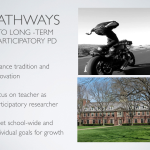
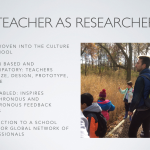
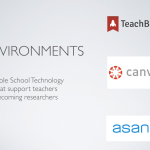
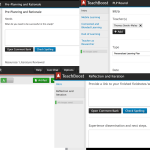
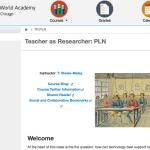
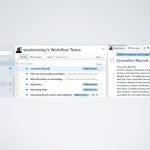
It was an honor to present for the second year with two incredible educators. Kim Sivick is a cofounder of the EdCamp movement and an EdTech maven and Scott MacClintic who is the founding director of the Kravis Center for Excellence in Teaching at Loomis Chaffee, a deep thinker, designer and teacher representing a new American Boarding Schools movement. In our presentation Kim will painted an amazing picture of what the landscape of what participant and tailor made professional development looks like across the world right now, Scott chronicled a successful movement to bring Unconferences and social media based professional development into some of the most elite Boarding schools schools in America and I summarized new forms in participatory teacher research for both professional development and resilient pathways of innovation in schools.
This is not easy work yet so many amazing things are happening in education. I hope we embolden a new generation of teacher researchers across our schools and learning ecologies that interweave both the innovators disposition and effective action we so badly need to see in education. Just as an armada of ecologists and citizen scientists are contributing to a systemic change in the way we see our health and well being, lets proliferate the same movement in education.
Your interest, thought, vision and ultimately your work is needed to transform our schools into learning ecologies that hold the best of tradition and see the frontier of innovation. I would love to hear how your school innovations are being studied, how you are managing the design and experimentation phases and who you are learning the most from in your networks.
1 I am starting a research process into how Kurt Hahn’s interwar schools like Salem supported teachers. I have found enough disparate reference to include my reference in text. As I paint a bigger picture for myself of the incredibly rich pre -UWC legacy of Hahn’s thinking and school practice I continue ot be amazed. This will undoubtably be a focus of future posts in the new year.
2 One of the best contextualizations of this point is found in Zuboff, S. and Maxmin, J. (2002) The Support Economy: Why Corporations are Failing Individuals and the Next Episode of Capitalism, pp. 77-78.
]]>