The world is in tumult and ecological, biological and one could argue social overshoot is upon us — but we still have wild places. Places where the Brown Bear hunts and rests, places where the Loon nests, places where the Sockeye run, places where the the Whip-Poor-Will still enchants and catches souls, where the wolf runs free, where the wolverine and lynx hunt unabated.
My thanks go out to every human who has fought to conserve and preserve our global wild lands. In the US, Muir and Roosevelt, joined by legions of you; I remember you — dedicated Student Conservation Association Volunteers (now theSCA), rangers, trailcrew, conservation biologists, wanderers, backpackers, philanthropists, companies, presidents.
Never before have our wild lands appeared so “fresh, so joyous, so immortal”.
As Thich Nhat Hanh has written, “the dandelion has your smile”….. I would add that the wild has your core. Please, on this Earthday be aware, act and in everyday live…..live knowing that as John Muir knew: “When we try to pick out anything by itself, we find it hitched to everything else in the Universe.”. Listen to the birds, yes, stop and smell the flowers, backpack a wilderness area, kayak a coast and if you can–contribute to the conservation and preservation of our last wild lands. You have my gratitude, thanks and comraderie.
Words to live by: http://lisa.steelemaley.io/words-to-live-by/
And an easy way to contribute: http://www.patagonia.com/vote-our-planet.html
Happy Earth Day.
]]>
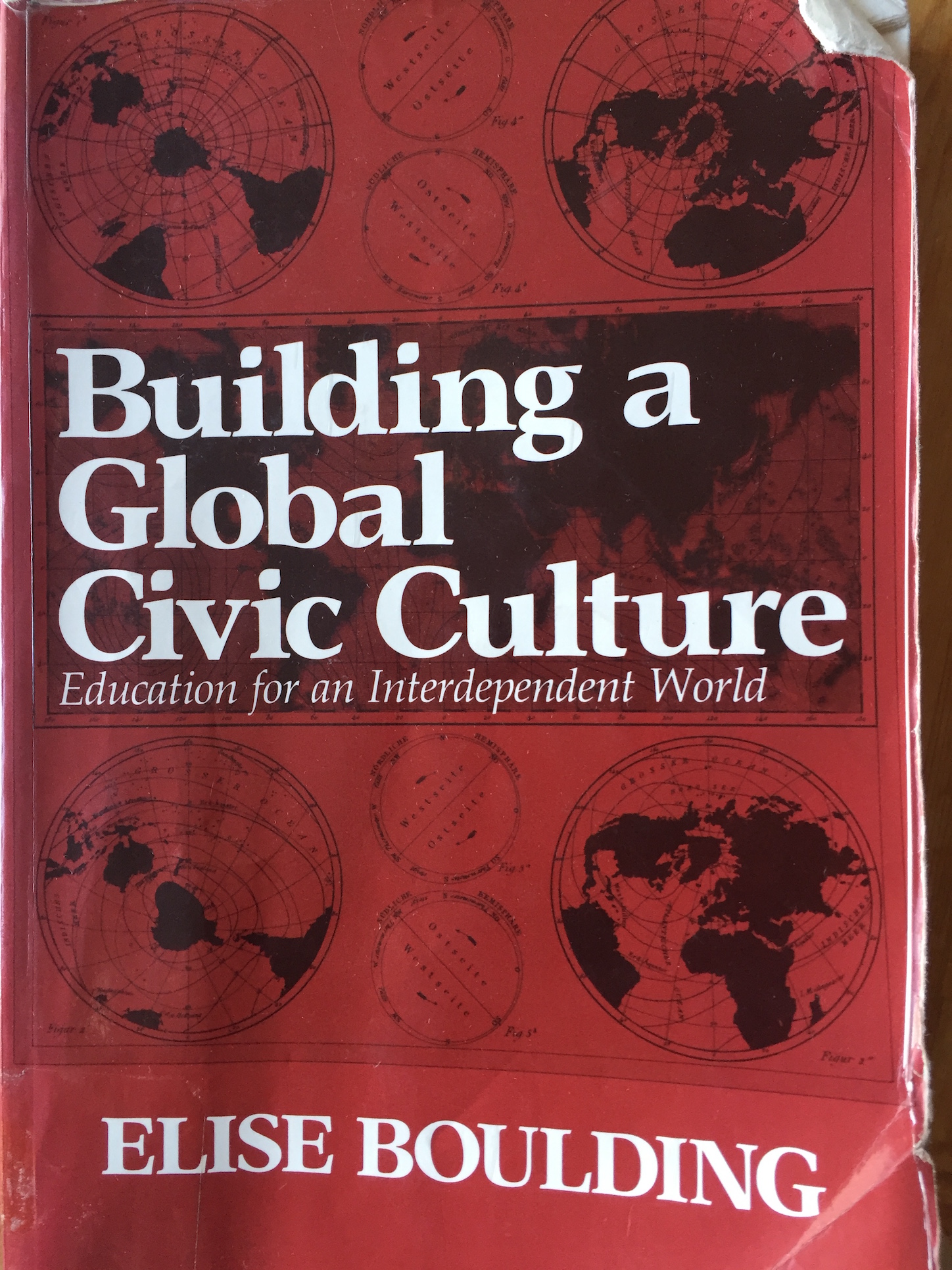
Boulding (1990) Building a Global Civic Culture: Education for an Interdependent World again…..
Imagining how events could be otherwise than they are is a hallmark freedom and power of human beings. Making social imagination work for us involves us in new concepts and principles, in new ways of using our minds to grasp complexities we do not yet comprehend. Thinking this way helps us construct new social realities both locally and globally. Social imagination is not merely for the sake of of academic knowing; it must include our feelings, and it must include our acting.
Hahn (1940) The Love of Enterprise, The Love of Aloneness, The Love of Skill
IF it be true that Education can heal the State, then indeed we educators have a grave and anxious responsibility.
]]>
Increasingly interested in Dave’s work on systems and structures. His erudite thoughts on complex adaptive systems immediately resonate with how humans learn vs how we engineer learning for humans in schools. In this talk he also introduces how his company Cognitive Edge uses what I have called Auto-Ethnography to awake participatory routes to change….I do believe we are headed, in the not so distant future, beyond education, where our self determination and indeed, applied ethnographies of ourselves will blend with cooperation and a new networked learning. In these new ecologies of education, concepts like Dave’s intergenerational fractal engagement will be common and could lead to mutual aid.
Perhaps Piper Hahn will indeed come alive in the actions of young people. And Networked Learning Ecology North America will illuminate a pathway or two.
]]>Opening Remarks KWEC13
Boulding (1990) Building a Global Civic Culture: Education for an Interdependent World again…..
Imagining how events could be otherwise than they are is a hallmark freedom and power of human beings. Making social imagination work for us involves us in new concepts and principles, in new ways of using our minds to grasp complexities we do not yet comprehend. Thinking this way helps us construct new social realities both locally and globally. Social imagination is not merely for the sake of of academic knowing; it must include our feelings, and it must include our acting.
Hahn (1940) The Love of Enterprise, The Love of Aloneness, The Love of Skill
IF it be true that Education can heal the State, then indeed we educators have a grave and anxious responsibility.
If one wishes to educate students to have a commitment to their social and ecological environment, one needs to start with an emphasis on commitment rather than on locality or community. Despite the commonly used metaphor, human beings do not grow actual roots on which they depend for their physical, intellectual, or ethical nourishment. Instead, nomads who have learned the ethical gestures of hospitality and openness to a community-to-come will bring nourishment to any place in which they land.
A few notes (of many) on Valve’s Employee Handbook.
]]>We want innovators, and that means maintaining an environment where they’ll flourish
Never be afraid to run an experiment or to collect more data.
This company is yours to steer—toward opportunities and away from risks. You have the power to green-light projects. You have the power to….
Why does your desk have wheels?
You were hired to constantly be looking around for the most valuable work you could be doing.
Nobody expects you to devote time to every opportunity that comes your way. Instead, we want you to learn how to choose the most important work to do.
Yes. There’s no secret decision-making cabal. No matter what project, you’re already invited. All you have to do is either (1) Start working on it, or (2) Start talking to all the people who you think might be working on it already and find out how to best be valuable. You will be welcomed— there is no approval process or red tape involved. Quite the opposite—it’s your job to insert yourself wherever you think you should be.
Sometimes things around the office can seem a little too good to be true. If you find yourself walking down the hall one morning with a bowl of fresh fruit and Stump- town-roasted espresso, dropping off your laundry to be washed, and heading into one of the massage rooms, don’t freak out. All these things are here for you to actually use. And don’t worry that somebody’s going to judge you for taking advantage of it—relax! And if you stop on the way back from your massage to play darts or work out in the Valve gym or whatever, it’s not a sign that this place is going to come crumbling down like some 1999-era dot-com start- up. If we ever institute caviar-catered lunches, though, then maybe something’s wrong. Definitely panic if there’s caviar.
Over time, we have learned that our collective ability to meet challenges, take advantage of opportunity, and respond to threats is far greater when the responsibility for doing so is distributed as widely as possible. Namely, to every individual at the company.
We all need feedback about our performance—in order to improve, and in order to know we’re not failing. Once a year we all give each other feedback about our work. Outside of these formalized peer reviews, the expectation is that we’ll just pull feedback from those around us when- ever we need to.
You’ve solved the nuts-and-bolts issues. Now you’re moving beyond wanting to just be productive day to day—you’re ready to help shape your future, and Valve’s.
Everyone is a designer. Every- one can question each other’s work.
Would I want this person to be my boss?; Would I learn a significant amount from him or her?; What if this person went to work for our competition?
Valve will be a different company a few years from now because you are going to change it for the better. We can’t wait to see where you take us.
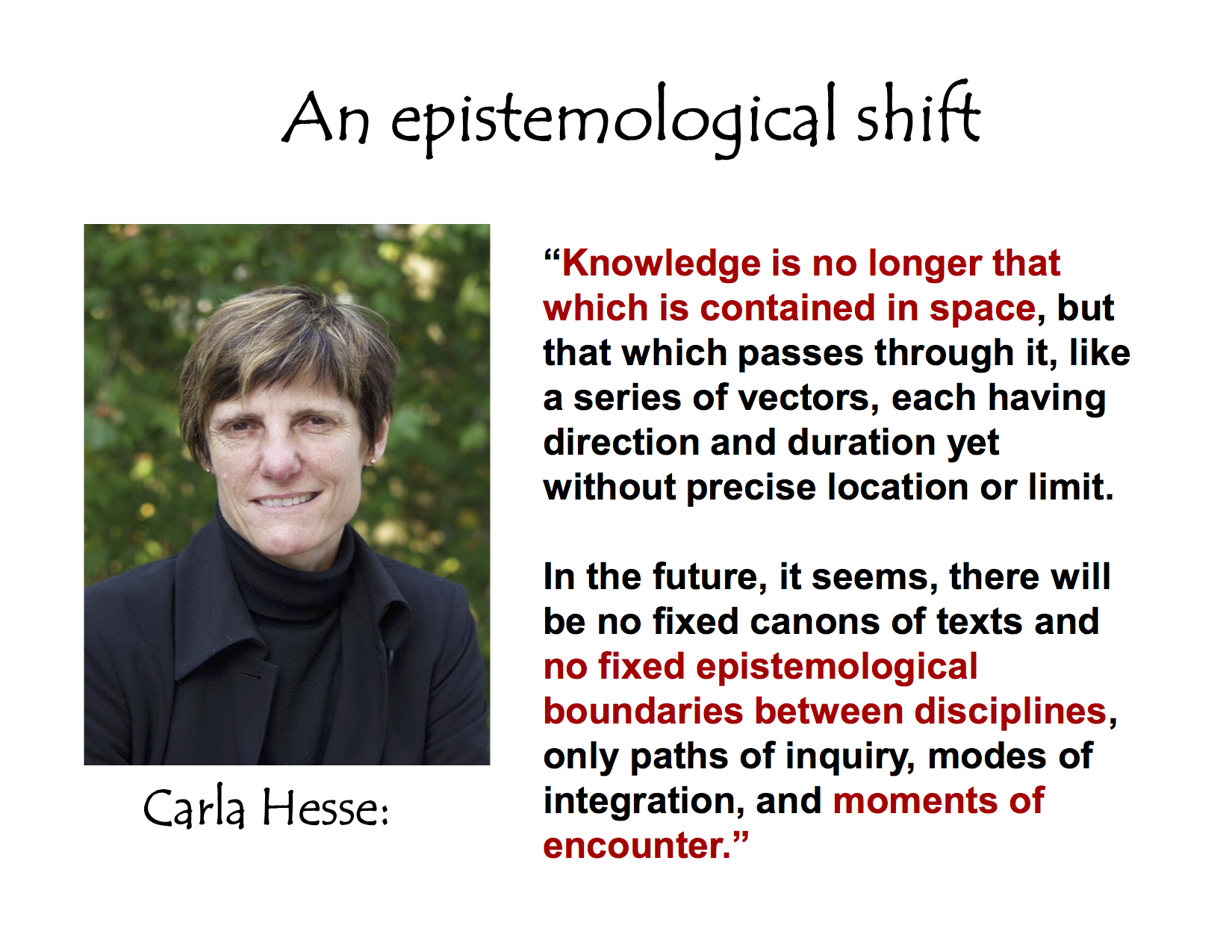
Still captivated by this slide from John Seely Brown. Carla’s adroit projections for the theory of knowledge are so prescient and useful.
]]>Imagining how events could be otherwise than they are is a hallmark freedom and power of human beings
D. Bob Gowin (1988)1
Many educational projects today are trying so very hard and nobly to mutate: to rescue, bypass, reconfigure and support–provide more than a catalyst, cool project or amazing school specific feat. The projects are seeking more, prototyping like mad and gaining grounds in certain spaces–I am wildly impressed by many. My hopes for you, for us, is that we face our dragons. Take a look at Bruce Sterlings NEXT talk from minute 8:58- With a brilliant critical voice, a pin drop hearing claim, and a passionate tenacity he implores a group of the best and the brightest (like you), to look up, look at the system, deeply question–yes keep questioning. Be forewarned, Bruce does not coddle, he offers critical deliberation for a complex world. But my point is not to posit yet another schools and sky’s falling argument. I want you to look up and ask yourself why the copier is still so important, why meetings are still so long, why that schedule is still not working, why the kids–even given control– are still only as good as the control given…. why they are still only engaging in “school”…. do the school and its processes exist for the students future? These, and so much more you see and feel as educators — are your dragons.
Before you undertake another school revision, plan, proposal, design or development please do the following.
In a safe and caring space spend a few hours minimum asking kids what their self and social concerns are. Have them write these concerns on a wall or in an online discussion. Their souls are churning; their adolescence, ever-present, but trust that the world they know, they may not show in school. When the writable surfaces on walls, discussion forums online and all in between (and beyond) are filled with life, pull colleagues with domain knowledge in all of the core subjects together to read and discuss. Agree on how creating projects from the life on those walls/spaces might meet all of your teacher/school objectives.
As elders, guides and yes, teachers you can support young people as they are involved and engaged in an enormous range of knowledge, from information to values clarification, and including content and skills from all disciplines of knowledge–integrated in the context of themes and activities within them. The topics you see written on the walls are organizing centers, significant problems or issues that connect the curriculum to the larger world. These centers serve as a context for unifying knowledge. Knowledge in turn is developed as it is instrumentally applied to exploring the organizing centers; Personal Knowledge: Addressing self concerns and ways of knowing about self; Social Knowledge: addressing social and world issues, from peer to global relationships, and ways of critically examining these; Explanatory Knowledge: content that names, describes, explains, and interprets, including that involved in the disciplines of knowledge as well as commonsense or popular knowledge and Technical/Twenty First Century Knowledge: ways of investigating, communicating, analyzing, and expressing. Finding,Validating, Leveraging, and Synthesizing Information; Communicating, collaboration and problem solving in a technologically rich environment.2
I would love to hear about your experiments and findings.
1.Boulding, E. (1990) Building a Global Civic Culture: Education for an Interdependent World
2. For more in this current of thought see Beane (1997) ‘Curriculum Integration: Designing the Core of Democratic Education’ essential reading.
]]>
Not unusual for Papert, his forcefulness around topics of education, computers and mathematics flow through the talk and one is left looking at machines anew (again). But that is not what resonated for me this time. Rather it was two statements at vastly different parts of the talk that I would like to briefly explore.
1. At minute 8.41, Papert speaks of educational change as “a very complicated social movement….[that]should be thought of as a complex system”….and goes on to propose the need for and a definition of a revolutionary in education:
(9.40) I don’t think of a revolutionary as someone who wants to force change, but one who looks far enough ahead to see that there is going to be change, fundamental change …
Fundamental change he argues, is out beyond the horizon of transformation. A Decade after Papert posits this are you looking ahead “far enough” do you see fundamental change? Is it upon us? Are you reading, networking and thinking daily about education as a complicated social movement– a complex system?
2. As Papert argues the salience of machines for teaching in this talk and for active learning, at one point he seems to open a dialectic and then veers away. He states, while addressing the active learning which mathematics was taught through in centuries past–
we cannot let kids sail seas and build pyramids anymore….
My mind raced, and heart pounded–yes we can, and I argue we should! Perhaps its the “2004” that Papert was within, perhaps he meant to inspire, perhaps it was a slipped metaphor, but no matter. Today, we are in a time of insatiable opportunity. A time where machines can be built by kids, and kids can write their own operating systems (as Papert states in the talk is a true test of computer use). Further, there are Labs like the Future Cities Lab , Superflux and Near Futures Laboratory along with so many other university, city, region and countrywide initiatives in research and design that are presenting incredible growth in society, media, computing and culture.
But importantly, kids can and should sail the seas and build the next pyramids to learn. This may be by computer inside a school–but more, I believe it will be a blend of spaces outside and in. Designing, prototyping and building–indeed our kids are doing this daily already through games, at home and in certain schools but we should be ready for more, much more. Keep working on what the new learning ecologies will look like for students young and old, keep designing, looking ahead, opening our minds to active, deep and experiential learning in 2015.
And there is no need to force change. In an incredibly honest and needed blogpost, Peter Gow argues so adroitly about why we need not belittle what has been or is in education as new ecologies of learning emerge. As another colleague Grant Lichtman argues in his book #Edjourney , educational mutation will be a vision and manifestation of the great middle grounds of education and experience in the 21st century. Keep sailing–keep building.
]]>
 ]]>