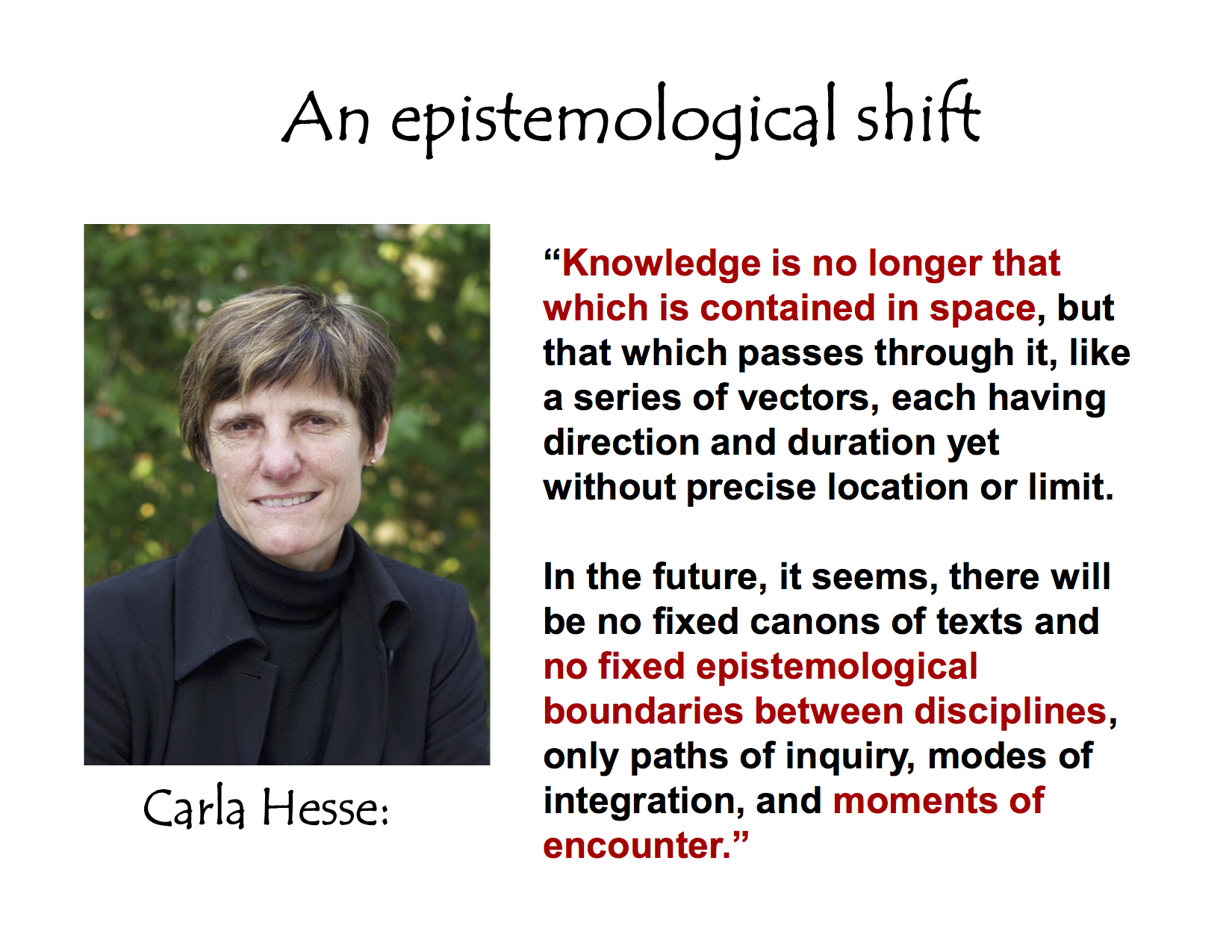
Still captivated by this slide from John Seely Brown. Carla’s adroit projections for the theory of knowledge are so prescient and useful.
]]>Though Sterling situates a role for design fiction in the disruptive innovation/innovators landscape (for a VERY talented crowd at NEXT13 ) he does much more in this talk. His call for a networked civil world is stunning, his scolding questions to the crowd about the facile nature of innovation and humanity even more so.
I realize now that so much of my instructional design has started with what I could call design fiction (though I have called it theorizing). My good friend Rob Greco has long discussed design fiction and encouraged me to think more broadly about the space. I will be doing this more over the year and exploring the obvious nexus between design fiction and the design thinking/making/diy movements afoot in education. This quote from Boulding (1996) keeps surfacing for me…..
Imagining how events could be otherwise than they are is a hallmark freedom and power of human beings. Making social imagination work for us involves us in new concepts and principles, in new ways of using our minds to grasp complexities we do not yet comprehend. Thinking this way helps us construct new social realities both locally and globally. Social imagination is not merely for the sake of of academic knowing; it must include our feelings, and it must include our acting.- D. Bob Gowin in Boulding (1998)
Here are a few links that Sterling mentions about those leading in the design fiction/human-design-innovation space.
Superflux: “is a collaborative design practice working at the intersection of
emerging technologies and everyday life to design for a world in flux.”
The Near Future Laboratory: who’s “goal is to understand how imaginations and hypothesis become materialized to swerve the present into new, more habitable near future worlds.”
Arup Forsight: who “research and raise awareness about the major challenges affecting the built environment and their implications. We also run events to help clients think more creatively about the long term future, and to manage risk and uncertainty more effectively.”
Design Interaction Program at RCA: who “are interested in the social, cultural and ethical consequences of emerging technologies, and this means asking probing questions through design. To this end, we encourage students to consider the implications, as well as the applications, of new technologies, and thus to seek fresh approaches to interaction design – approaches that are meaningful and relevant today. In short, we see this field of design as a fertile way of thinking about the life around us, within us, and in the future beyond us”.
]]>
Sound doxa on critical education, deschooling, open learning, complexity in reform, technology in education.
]]> Thank you to Roberto Greco for pointing me to more of Colin Wards work
More on TheNewHive
The New Hive from TheNewHive on Vimeo.
]]> Leigh Blackall presents a new view of learning that is critical, open, networked and participatory through his research. In a recent twitter stream and blog post he is asks for collective and open deliberation for a definition of networked learning. As a participant involved in networked learning research and praxis I will offer the following as an entry into the collective imaging and deliberation.
Definitions
Open: Learning is free from institutions or understood to be actively participating in non-institutional learning.
Critical: learning does no harm or actively works for social, economic, and environmental sustainability and resilience.
Participatory: learning is integrative and inclusive of participants regardless of skill level or pre-determined social hierarchy.
Networked: learning happens in a blended mesh. Learners, pedagogues, and others are nodes that exchange information to different degrees, depths and forms both online and in the field.
The best defense of these definitions I have found is presented here by Steven Downes:
Image above: Watts and Strogatz model/small world network graph, credit: Arpad Horvath
]]>