M. Kat Anderson presents a wealth of information on native land management practices gleaned in part from interviews and correspondence with Native Americans who recall what their grandparents told them about how and when areas were burned, which plants were eaten and which were used for basketry, and how plants were tended. The complex picture that emerges from this and other historical source material dispels the hunter-gatherer stereotype long perpetuated in anthropological and historical literature. We come to see California’s indigenous people as active agents of environmental change and stewardship. Tending the Wild persuasively argues that this traditional ecological knowledge is essential if we are to successfully meet the challenge of living sustainably.”
]]>…”the history of education loses much of its meaning when it is formalized in terms of selected institutions, when school and society are disassociated.” (x) – From the forward written by Cappon.
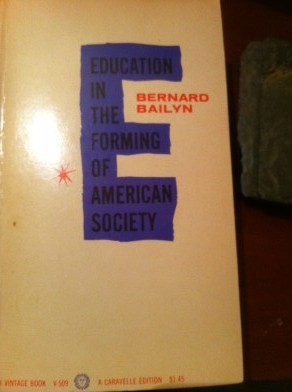
This Spring I am involved with a group of educators from all political spheres focused on education, rural America and innovation. For our first read I suggested Baiyln (1960) Education in the Forming of American Society, University of North Carolina Press. We start next week.