Most schools today have suffered a standardization epidemic almost as potent as the worst epidemics of health and ecology imaginable. To be fair, this standardization ensured the largest single boost to global education in modern times.2 Just as the cure to epidemics created immunities, so to did we create institutional immunity to the kinds of learning innovation we would like to see today. This immunity fights against change as strongly as antibiotics fight bacteria. Now, as we look for holistic approaches to the health of our populations, we must also look for our institutions–our schools. We now know what causes many diseases and what over medication does to our children. But what of our penchant for holding onto blanket prescriptions for our schools health?
This is the era of looking systemically at the individual, the environment and indeed the ecology of learning again. Instead of being radicals, those who are taking this path are the pioneers of a new world. Sounds bold, but really it is on all educators minds, every headmaster and for the world of independent schools I identify with most–our parents minds. Yes, if you graduate form an elite boarding school, you are likely to get into the college of your choice, but what of your prospects there? Your prospects in life…. regardless of income? These are the questions I am asking as a parent, and the parents I serve are asking of me.
It’s time to innovate, and stake claims anew to a world of learning that has so boldly expanded it frightens even the most agile school leader. To innovate is to create pathways that others can benefit from, not just offer catalyst moments for others to be amazed by. Tackling problems like:
- weaving experiential and scholastic learning together,
- learning outside of the classroom for extended amounts of time (be it online or field studies based),
- personalizing the learning process (a personal learning plan for all),
- balancing tradition with innovation to ensure the legacies and innovations are translated together,
takes extensive effort, tireless imagination and action.
To create pathways for innovation we must replace myths with methods. I strongly believe one seminal way to do this is through teachers being participatory researchers in the innovation process. Opening up our innovation process to ongoing and meaningful contributions from everyone in our institution not just surveying opportunities offered in professional development or school initiatives, but offering ongoing involvement in a measured cycle of experimentation for the practitioner. This is sustained, measured participatory research driven by the end users to contribute to innovations on the ground.
It is time to take the Skunkworks across the school. Does your school reflect the change in knowledge and networks ever present in today’s world–at a systemic level? Are you visioning for this world, translating that vision into practice with your managers as well as your mavericks? Are you collecting longitudinal evidence both qualitative and quantitative that it’s working? I believe many in the audience reading this post do have a good start on this (A direct nod to Brett Jacobsen, Bo Adams and Team at Mount Vernon Presbyterian). I want us to create networked and sustainable pathways for innovation in education together.
On Friday at the annual TABS 14 Conference, I discussed a few solutions that flatten participation in the design, prototyping and iteration process for innovation in educational change.
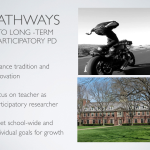
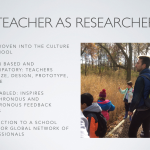



It was an honor to present for the second year with two incredible educators. Kim Sivick is a cofounder of the EdCamp movement and an EdTech maven and Scott MacClintic who is the founding director of the Kravis Center for Excellence in Teaching at Loomis Chaffee, a deep thinker, designer and teacher representing a new American Boarding Schools movement. In our presentation Kim will painted an amazing picture of what the landscape of what participant and tailor made professional development looks like across the world right now, Scott chronicled a successful movement to bring Unconferences and social media based professional development into some of the most elite Boarding schools schools in America and I summarized new forms in participatory teacher research for both professional development and resilient pathways of innovation in schools.
This is not easy work yet so many amazing things are happening in education. I hope we embolden a new generation of teacher researchers across our schools and learning ecologies that interweave both the innovators disposition and effective action we so badly need to see in education. Just as an armada of ecologists and citizen scientists are contributing to a systemic change in the way we see our health and well being, lets proliferate the same movement in education.
Your interest, thought, vision and ultimately your work is needed to transform our schools into learning ecologies that hold the best of tradition and see the frontier of innovation. I would love to hear how your school innovations are being studied, how you are managing the design and experimentation phases and who you are learning the most from in your networks.
1 I am starting a research process into how Kurt Hahn’s interwar schools like Salem supported teachers. I have found enough disparate reference to include my reference in text. As I paint a bigger picture for myself of the incredibly rich pre -UWC legacy of Hahn’s thinking and school practice I continue ot be amazed. This will undoubtably be a focus of future posts in the new year.
2 One of the best contextualizations of this point is found in Zuboff, S. and Maxmin, J. (2002) The Support Economy: Why Corporations are Failing Individuals and the Next Episode of Capitalism, pp. 77-78.
]]>]]>
“Imagining how events could be otherwise than they are is a hallmark freedom and power of human beings. Making social imagination work for us involves us in new concepts and principles, in new ways of using our minds to grasp complexities we do not yet comprehend. Thinking this way helps us construct new social realities both locally and globally. Social imagination is not merely for the sake of of academic knowing; it must include our feelings, and it must include our acting.”- D. Bob Gowin in Boulding (1998)
]]>
]]>
Sound doxa on critical education, deschooling, open learning, complexity in reform, technology in education.
]]>More on TheNewHive
The New Hive from TheNewHive on Vimeo.
]]>Stephen Downes:
- Slideshare: Groups vs Networks: The Class Struggle Continues
- Stephen Downes identifies significant differences between networks and groups, along four major axes. Drawn but not discussed at the Future of Learning in a Networked World event in Aukland, New Zealand. This short video explains the drawing at http://www.flickr.com/photos/stephen_downes/252157734
Florian Schneider:
Roberto Greco:
More to come….
]]> Leigh Blackall presents a new view of learning that is critical, open, networked and participatory through his research. In a recent twitter stream and blog post he is asks for collective and open deliberation for a definition of networked learning. As a participant involved in networked learning research and praxis I will offer the following as an entry into the collective imaging and deliberation.
Definitions
Open: Learning is free from institutions or understood to be actively participating in non-institutional learning.
Critical: learning does no harm or actively works for social, economic, and environmental sustainability and resilience.
Participatory: learning is integrative and inclusive of participants regardless of skill level or pre-determined social hierarchy.
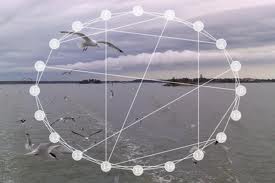
Networked: learning happens in a blended mesh. Learners, pedagogues, and others are nodes that exchange information to different degrees, depths and forms both online and in the field.
The best defense of these definitions I have found is presented here by Steven Downes:
Image above: Watts and Strogatz model/small world network graph, credit: Arpad Horvath
]]>