]]>
A. The Luddites knew their machines better than most and
B ( A Question….) were the Luddites fighting machines or autocracy and the subversion of the commons–the factory?
These interactions with academicians occasionally wield deliberative dialogue that I feel is vital in the worlds of education today and hinge on questions, the most important of which may be.
Do the machines of today and the internet have a massive potential for enabling human self determination?
Undoubtably we must seek to understand machines well….so we can also understand the stupefacient uses that hold court in so many networked environments today.
Networked Learning holds a potential for the human to be engaged in a ubiquitous free and wild relationship with other humans and themselves. To do so wwe must act to enable networked (digital and face to face) learning ecologies that promote freedom, conviviality and mutual aid while also questioning our use of machines with deep and active awareness. For when machines enable the erosion of our free convivial and mutual lifeways we to must raise ourselves into a new-Luddite movement for change.
]]>
Some 10 years ago I sat across from an Aerial Wolf Hunting Lobbyist in Juneau AK as a long beard, back to the lander with AK roots. He was a brilliant old timer: healthy, clean shaven, calloused, and tucked in….a big city (relative) look. Visiting my father (also lobbying) we had sat for breakfast in the oldest hotel in town. I could not stop looking at this man. I was doing work informally on reserve design for the Yellowstone to Yukon initative and was as I still am, a proponent of balance in ecological systems….read predators as keystone species…. Legislation was up to challenge shooting wolves from airplanes and I agreed with it. He looked like he may have a differing opinion so I engaged him and will never forget the learning that took place that day.
Me: “Are you here for the legislative session”
Old Fellow: “Yes, I am….I’m here to support aerial hunting”
I remember being startled that he would engage me in this way
Me: “Why do you support killing wolves”
Old Fellow: “Its about balance, son”
He went on to describe how in the 1950’s and 1960’s the wolf management program disrupted the ecosystems in drastic ways and created an imbalance that will take radical and systemic change to right. In his community of McGrath, though there where disagreements, a susbistence life was built around Caribou, tourism and self sufficiency….he was not about to let his lifeway go without evidence of how disrupting the “new” balance (keeping wolf populations low dealing with bear predation on fawning caribou….) was viable on the ground. He was not going to allow a tight knit group of bush dwellers to suffer for peoples lofty philosophy. Theirs was a deep opinion and way of life. It was political, economic and environmental.
This meeting has been a clarion call for me. Since that time I have studied why the “balance” in the world exists and specifically why school reform and tinkering toward utopia (Tyack 1995) fails to address the core balance in education and learning. Lobbing softballs in education around PISA and the common core, fixing teachers, students and schools because it is the “right thing to do” does not address the realities of balance and what it takes to change the cultural institution of schooling. Their is a holistic imbalance in learning. The American people do not see why education needs to be changed because the institutions that they participate in have not changed. AP, IB, honors, regents, common core, school re-design, teacher education and beyond feed a static process to enforce an almost 200 year balance and re-balance would effect every aspect of America and in turn the world. Our educational system exists to school a population into 19th and 20th century social, economic, and environmental patterns. These patterns need to be discharged, or detoxed as Monika Hardy and the Innovation Lab of Colorado practice. Furthermore as Illich envisioned in Deschooling society, the very fabric of society will need to awaken and act in new designs and systems. Yes there are growing vestiges of these innovations. However, these vestiges will need to get to the heart of political engagement, move away from ideological trends, and embrace each other through the messiness of their call for peer to peer ecologies. If this process of mutual aid, doxa and thaumadzein is networked, the balance in learning will correct like an ecological system and self organize.
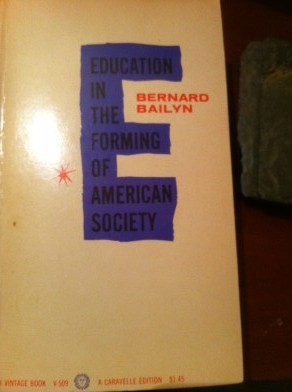
]]>…”the history of education loses much of its meaning when it is formalized in terms of selected institutions, when school and society are disassociated.” (x) – From the forward written by Cappon.
This Spring I am involved with a group of educators from all political spheres focused on education, rural America and innovation. For our first read I suggested Baiyln (1960) Education in the Forming of American Society, University of North Carolina Press. We start next week.

One of Colin Ward’s greatest contributions was his focus on childhood and the built environment. This interest first appears in a chapter of Anarchy in Action (1973) – ‘Schools No Longer’ – where Ward discusses the genealogy of education and schooling, in particular examining the writings of Everett Reimer and Ivan Illich, and the beliefs of anarchist educator Paul Goodman. Many of Colin’s writings in the 1970s, in particular Streetwork: The Exploding School (1973, with Anthony Fyson), focused on learning practices and spaces outside of the school building. In introducing Streetwork, Ward writes, “[this] is a book about ideas: ideas of the environment as the educational resource, ideas of the enquiring school, the school without walls…” (1973: vii). In the same year, Ward contributed to Education Without Schools (edited by Peter Buckman) discussing ‘the role of the state’. He argued that “one significant role of the state in the national education systems of the world is to perpetuate social and economic injustice” (1973: 42). Here, we can again see the inter-relatedness between Ward’s own experiences, politics and writings. Ken Worpole, fellow writer and collaborator, reflects on this period of Colin’s work, which also included the initiation of a Bulletin of Environmental Education through the Town and Country Planning Association:
The point…was to help get children out of school and into their communities, to talk to local people, and explore their neighbourhood, its amenities and utilities, and understand how buildings, streets, landscapes and social life interact. This led to Colin’s focus on the unique world of childhood which, in the end, may prove to have been his – and anarchism’s – most enduring contribution to social policy. (Worpole, 2010)
Indeed, in The Child in the City (1978), and later The Child in the Country (1988), Ward examined the everyday spaces of young people’s lives and how they can negotiate and re-articulate the various environments they inhabit. In his earlier text, the more famous of the two, Colin Ward explores the creativity and uniqueness of children and how they cultivate ‘the art of making the city work’. He argued that through play, appropriation and imagination, children can counter adult-based intentions and interpretations of the built environment. His later text, The Child in the Country, inspired a number of social scientists, notably geographer Chris Philo (1992), to call for more attention to be paid to young people as a ‘hidden’ and marginalised group in society. Ward, however, was keen to stress the individuality of children and their educational needs, quoting cultural anthropologist Margaret Mead that “it’s a good thing to think about the child as long as you remember that the child doesn’t exist, only children exist, every time we lump them together, we lose something.” (1978: vi) Ward was also an educator himself as a teacher of Liberal Studies at Wandsworth Technical College in South London during the 1960s. This grassroots experience of education, including his work as an Education Officer, gave Ward’s writing an authoritative and yet sympathetic edge. This quality, combined with his passionate and long-held concern with the politics of place, makes Colin Ward an inspirational key thinker.
Mills, S. (2010) ‘Colin Ward: The ‘Gentle’ Anarchist and Informal Education’ the encyclopaedia of informal education.[www.infed.org/thinkers/colin_ward.htm].
]]>