
Illich, I. (1973). Tools for conviviality. New York: Harper & Row.
]]>The symptoms of accelerated crisis are widely recognized. Multiple attempts have been made to explain them. I believe that this crisis is rooted in a major twofold experiment which has failed, and I claim that the resolution of the crisis begins with a recognition of the failure. For a hundred years we have tried to make machines work for men and to school men for life in their service. Now it turns out that machines do not “work” and that people cannot be schooled for a life at the service of machines. The hypothesis on which the experiment was built must now be discarded. The hypothesis was that machines can replace slaves. The evidence shows that, used for this purpose, machines enslave men. Neither a dictatorial proletariat nor a leisure mass can escape the dominion of constantly expanding industrial tools.
The crisis can be solved only if we learn to invert the present deep structure of tools; if we give people tools that guarantee their right to work with high, independent efficiency, thus simultaneously eliminating the need for either slaves or masters and enhancing each person’s range of freedom. People need new tools to work with rather than tools that “work” for them. They need technology to make the most of the energy and imagination each has, rather than more well−programmed energy slaves.
I believe that society must be reconstructed to enlarge the contribution of autonomous individuals and primary groups to the total effectiveness of a new system of production designed to satisfy the human needs which it also determines. In fact, the institutions of industrial society do just the opposite. As the power of machines increases, the role of persons more and more decreases to that of mere consumers……
I choose the term “conviviality” to designate the opposite of industrial productivity. I intend it to mean autonomous and creative intercourse among persons, and the intercourse of persons with their environment; and this in contrast with the conditioned response of persons to the demands made upon them by others, and by a man−made environment. I consider conviviality to be individual freedom realized in personal interdependence and, as such, an intrinsic ethical value. I believe that, in any society, as conviviality is reduced below a certain level, no amount of industrial productivity can effectively satisfy the needs it creates among society’s members…..
As citizens have new choices, new chances for learning, their willingness to seek leadership should increase. We may expect that they will experience more deeply both their own independence and their need for guidance. As they are liberated from manipulation by others, they should learn to profit from the discipline others have acquired in a lifetime. Deschooling education should increase — rather than stifle — the search for [people] with practical wisdom who would be willing to sustain the newcomer in his educational adventure. As masters of their art abandon the claim to be superior informants or skill models, their claim to superior wisdom will begin to ring true. –Illich (1970)
To Exhibit Learning
Exhibitions beautifully disrupt institutions and show deep learning. An exhibition, in short, is a public presentation of learning. Exhibitions are practiced at all levels of education and in all fields. A learner or group of learners publicly exhibit their understanding of knowledge territories and connect learning to relevant issues of today. This is important and hard work that shows the individual and group that learning does not only happen within the walls of an institution but is a matter for society in general. Inviting the public to view, question, comment, and participate in a learning community reveals, connects and networks learning communities. Exhibitions also decolonize the pedagogue. When educators open their process or teaching to the outside world they ensure an essential conversation to ensue on the import of the work they do. Whether you adhere to Ted Sizer and the Coalition of Essential Schools vision of exhibitions as assessment or just agree with performance assessment being public I have no doubt that you see the benefit of opening the learning process to communities outside of your institution, school, room…. in dynamic ways.

Enmesh our pedagogy with the world
Dynamism and the ability to imagine, collaborate, and co-design learning environments are hallmarks of effective pedagogues today. These are all skills that are not learned in the semester course on literacy or technology in education. Many of us face institutional constraints in our work in education and seek ways to open our learning communities. We work to collectivize, democratize, co-create and enable personal and group passions for flow in learning. Many of us have been, as a passionate educator once told me I would become prior to my first classroom experience, ” a coalition in your own classroom” (sub whatever you want to imagine to replace coalition in your situation). But this is not enough. Learning is an ecology that is interconnected and interdependent. We must share our communities work, we must exhibit, the whole ecology must weigh its social imagination into the mix….We need to show learning, failure and iteration and ask for feedback, connect and network our work on new levels…. we must enmesh our pedagogy with the world.
Open a human creation
Exhibitions open education to the world. In the process of preparing for public participation in learning the individual looks deeply at the connections they are making….the common good in their endeavor….their learning moves from 8-3, 12:30-1:30, Tuesday and Thursday to their heart. When you face the public you face your heart….Yes nerves flash signals and the body quivers upon the thought of being on stage, but your heart tells the story. For the young person in high school the story might be “what does it mean to go to school in the 21st century….what is ‘world history’ ‘literature’, ‘science’, ‘my life’…. For the pedagogue the story needs to be ” ‘what am I undertaking’, ‘what role do I have in society’, ‘who may look to me’, ‘how will I collaborate with the world’….”. As one who believes in the commons and in learning as ecology I want to see more than a transcript and degree from any institution from “masters” of pedagogy or any field. I want to see a heart beating, a passion for learning….something different from books and sites….a human creation.
Find a learning ecology
Join me in finding ways to open education. Exhibitions are just one of these ways. We who have decided to be pedagogues as part of our learning ecology will benefit from making the learning communities we work within visible. This networking will help other communities change, become dynamic, and change again to make learning dynamic, resilient, and ubiquitous.
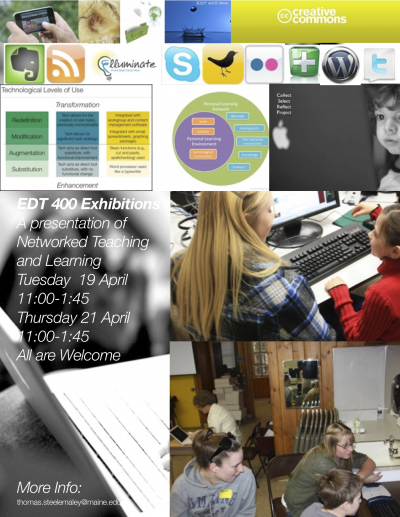
This week is exhibition week in one of the learning communities I work with
I look forward to being a part of this meaningful time.
Greco
We need them….dedicated and passionate teachers and learners who see learning as a design that the learner moves, shapes and feeds forward as positive action in our world….educational communities need them, those with social imagination….experts, yes experts. The more I get to know Rob Greco the more he reminds me of Illich’s (1970) “people with special educational competence”.
Three types of special educational competence should, in fact, be distinguished: one to create and operate the kinds of educational exchanges or networks outlined here; another to guide students and parents in the use of these networks; and a third to act as primus inter pares in undertaking difficult intellectual exploratory journeys….To design and operate the networks I have been describing would not require many people, but it would require people with the most profound understanding of education and administration, in a perspective quite different from and even opposed to that of schools.
Greco lives his educational experiences with the learners in his communities….he sees the messiness in learning, breathes deep of the essence, and trusts in the human capacity for mutual aid….I witnessed the outcome of that journey in an Elluminate session on Tuesday. The middle level learners Rob guides worked as a community to exhibit what was important to them about learning and life. I was awestruck with joy and hope.
Blackall
Leigh continues to amaze me. After a brief blogging hiatus, he is right back with thought provoking work, feeding forward amazing resources and inspiring. His recent thoughts on “ubiquity” contribute much to the deschooling and networked learning conversation. Feeding forward Ian Hart’s (2001) Deschooling and the Web was welcomed reading this week.
Hine
Howard Rheingold’s bookmark quest for P2P learning networks brought me right back to Dougald Hine’s School of Everything page. I delved into his links on Free U, The Learning Exchange and the Young Foundation
Littky
If your not on the edge, you’re taking up to much space
I have read, watched and learned from Dennis for many years….I am more amazed than ever.
See
Big Picture Learning Profile
College Unbound
Much more….P2P Foundation Wiki Blog
]]>

A video and education reform’s 100 year failure
A timely video inspired by Michael Wesch came across my desk today and it comes at an interesting time in my thinking on education. The Future of Ed Reform? weaves a very short yet potent story about the realities so many of us face who seek to radically change the structure of education from “places of schooling” to “places of learning”.
I have written about critical education in many posts and realize that most of my ideation, design and praxis towards democratic education has met with the realities of institutions, schooling an societal structures around education and official knowledge. I would like to say I met these challenges and take the path I do now, knowing I stand on the shoulders of progressives and a hundred years of work from John Dewey, L. Thomas Hopkins et al., and their contemporaries James Beane, Micheal Apple, Deb Meir and so many others who are in the field not writing prolifically but fostering experiences and learning.
The Future of Ed Reform begs questions of reform and stasis in education. “If so many years of reform, (including some almost 100 years old that espouse the same reform we are seeking in education today) have failed why do we think it will work….this time.” A good question and one I had with a visionary leader and progressive educator in the field just yesterday: More on this in future posts.
The author of Future of Ed Reform is right to question these new “reforms” and their ability to succeed. The authors points at “the revolution failed” are right. The use of Dewey as an example is illustrative of the issues here. Dewey, Francis Parker, L. Thomas Hopkins et al. faced a backlash from an American society bent on order and standardization. Though their reform was brilliant and on the mark in many ways, school in the 20th century was an institution based on order and control just as it is today. Today as in the 20th century, linear schedules, corporate curricula, and the extra-curricularization of energy and interests still combine to hold firm what has been at the expense of what is. The School structure and its meanings are the issues of today just as they where a century ago.
Dewey did call for a revolution from schooling to learning, and espoused among so many brilliant ideas a call for deschooling on the grounds that control and order do little for learning. Dewey (1938) reflects,
Almost everyone has had occasion to look back upon his [and her] school days and wonder what has become of the knowledge he was supposed to have amassed during his [and her] years of schooling….but it was so segregated when it was acquired and hence is so disconnected from the rest of experience that it is not available under the actual conditions of life. (p.48)
We must reflect presently on the “reform” engines of today motoring throughschools and quietly accepting the structures imposed in what amounts to seeing learners and their communities as commodities and economies of scale, versus dynamic realities of human possibility. The author of The Future of Ed Reform? is calling out the realities of societal structures and the school not the reform which may have similarity to our 100 year past.
To Create, To Design
It is no mystery to many that I favor the design of new learning Ecologies that leverage much of what Dewey et.al espoused and practiced in the fields of experiential and democratic education. I have also focused my work on the networking of blended learning ecologies. A combination of Illich’s learning webs, the mesh ideas of OLPC and my roots in experiential and mobile learning in the big outside. This design like so many is at risk when placed against the onslaught of stasis in education. No Softballs here, we have heard them in detail. Yet I find myself asking are we ready for a networked learning ecology? Is society? What will it take?
So anthropologists, critical educators, deschoolers, unschoolers, reformers, what will make your vision work? Are you part of a revolution? If so why, and will that revolution be enough force to break the dam of traditional control and order schooling to create or recreate places of learning for society? I am interested in hearing your voice and working with you.
]]>
From: Yong Zhao » Blog Archive » A Nation At Risk: Edited by Yong Zhao. (n.d.). Yong Zhao. Retrieved March 11, 2011, from http://zhaolearning.com/2011/03/10/a-nation-at-risk-edited-by-yong-zhao/
Indicators of the Risk
The educational dimensions of the risk before us have been amply documented in materials read by this editor. For example:
- For
the first time, research shows American creativity is declining. Since
1990, Americans’ creativity scores have been on the decline
significantly and most seriously among young children (from kindergarten
through sixth grade). - As
a result of No Child Left Behind (NCLB), a significant number of
schools in America have narrowed their curriculum by cutting arts,
music, physical education, social studies, science, recess, or lunch.
“Forty-four percent of all districts nationwide have added time for
English language arts and/or math, at the expense of social studies,
science, art and music, physical education, recess, or lunch.” - Meanwhile, our competitors such as China and Singapore
have been decreasing their instructional time for math and increasing
time for creativity, critical thinking, arts, physical education. For
example, since 1999 China has decreased total instructional hours by 380
for grades 1 through 6, reduced math instruction by 140 hours and added
156 instructional hours for physical education. - Unethical
and dishonest behaviors have become rampant in American education.
Teachers, school administrators, and students have been forced to engage
in all sorts of cheating to raise test scores and state governments
lower standards to avoid penalties. - America
spends $1.1 billion dollars per year testing their children under NCLB
while many schools have to cut short instructional hours and or lay off
teachers due to budget cuts. - In
2004–2005, Wisconsin students spent a total of about 1.4 million hours
taking state tests; with full implementation of NCLB testing, that
number will more than double, to 2.9 million. These figures do not
include the time spent distributing and collecting materials, taking
practice tests, giving instructions, and addressing other logistics of
testing. - American teachers’ morale has reached a crisis level. Over a quarter of teachers leave the profession within the first three years and nearly half leave within the first five.
- Teacher unions, the last organized line of defense for public education, are being threatened across the nation.
- Yet,
the governments continue to impose policies that connect teacher
evaluation with student test scores although research has clearly shown
that such policies do not improve student learning, even measured by
test scores. - American education has become a nationalized standardized
education system. Locally democratically elected school boards have been
rendered bureaucratic assistants of the state and federal government to
enforce implementation of state and federal mandates rather than
guarding the education of their children. - Less
than 20% of American students are enrolled in a foreign language course
while all Chinese students are required to study a foreign language
beginning from third grade at the latest. - Only 11 percent of twelfth graders nationwide demonstrated proficiency in U.S. history.
- More
than 80 percent of New York City eighth graders did not meet the state
standards in social studies in 2004. Moreover, the number of students
meeting the social studies standards has decreased by almost 20
percentage points since 2002. - 25
percent of college-bound high school students could not name the ocean
between California and Asia. 80 percent of young Americans (ages 18 to
24) did not know that India is the world’s largest democracy; 37 percent
could not locate China on a map of Asia and the Middle East. - The
average number of languages spoken by American business executives is
1.5, compared with an average of 3.9 languages spoken by business
executives in the Netherlands. - Business
and military leaders complain about the lack of international and cross
cultural skills of American graduates. “A 2002 survey of large U.S.
corporations found that nearly 30 percent of the companies believed they
had failed to exploit fully their international business opportunities
due to insufficient personnel with international skills. The
consequences of insufficient culturally competent workers, as identified
by the firms, included: missed marketing or business opportunities;
failure to recognize important shifts in host country policies toward
foreign-owned corporations; failure to anticipate the needs of
international customers; and failure to take full advantage of expertise
available or technological advances occurring abroad. Almost 80 percent
of the business leaders surveyed expected their overall business to
increase notably if they had more internationally competent employees on
staff.”
Time to Deschool
Powered by ScribeFire.
]]>
A day in the learning ecology of Piper Hahn
Piper is a 15 year old who lives in Midcoast Maine, US. A year ago, Piper heard about a new way to learn, and decided to take part in a new learning experience called the Maine Networked Learning Project. Known as “the Mesh” to participants, this learning ecology offered Piper the chance to apply her passion for learning in highly experiential and collaborative ways with groups of young people of varied ages, adult and youth mentors with knowledge territory specialties and organizations focused on ensuring sustainable and resilient societies, economies, and the environment. This is a snapshot of her day.
A day in the learning ecology of Piper Hahn
Piper gets ready for her week by sitting outside sipping tea and looking at her smart phone. She is checking project updates sent from the team she has been working with for the last two months on her Google Reader and Twitter feed. The project Piper is checking in on deals with food justice in the rural communities of her bioregion.
Seeing many updates, and much activity she decides to look at the overall “mesh” schedule for the day. She notices that the MNLP van will be moving across the local region starting in an hour. To get a ride on this local transportation system she has to ride her bike to a station stop or have her parents drop her off at the regional mesh meet-up location. But before deciding this she reviews her weekly schedule on her mobile.
Piper notices that she and three others will be presenting at the local Veterans of Foreign Wars organization to a large group on the history of local food cultivation in the region. She and her Food Justice project group have spent a good deal of time completing ethnographic studies of the areas “locals”. These participant interviews are seminal to their presentation as they show that local sustainability and resilience projects are not “outside” or “rich Peoples” pursuits, but can save local economies and the historical heritage this stakeholder group cherishes. The group has also been working in restoration crews on local farms as a service learning tie in to their studies. The project has been extensive. Piper and her group have covered mathematics, experimental sciences, writing, social sciences and much more in an integrated project framework. They have relied on their mesh mentors, local experts, and the internet for research, recording (writing, video) and exhibiting their knowledge and understanding to multiple community stakeholder groups.
As the project presentation pre-work is done, Piper contacts her group via twitter hashtag to remind all that they will need an hour to meet-up before the presentation and to ride their bikes to the VAW hall from the meet-up. Immediately she gets a response from three of the four other group members that they will meet prior to the VAW event. They remind each other that a collaborative learning session will be going on for applied algebra and trigonometry concepts at Noon. This session will be special, as an innovative regional planner from rural Scotland will be mentoring at the Self Organizing Learning Environment today along with their local quantitative reasoning/systems thinking mentors. She video chats with one participant letting her know that she will be at the SOLE, and is hoping to get a ride to her house after today’s VAW presentation. That done, Piper checks with her parents and decides to ride her bike to a mesh station stop. She then rides the mesh van into town and catches up on posts and replies in her Reader on the way.
At the Meet-up location (a wide open space that reminds Piper of a open market of some kind), she settles in with the other young people in study, discussion and deliberation. Today she takes out her tablet and reads a work in global literature that was suggested by a mentor she has in South Asia. She will take notes on the work over the next hour and send those notes via blog post to the mentor. The mentor, other participants and Piper are involved in a global project combining cultural understandings of place into a wiki resource for future learners to use. She sees connections everywhere in her learning and after being inspired by an experience in India she’s just read about, Piper adds content for today’s VFW presentation to the shared presentation document for group review.
Piper takes a run with others from the meet-up, and then decides to review the quantitative reasoning skills that figure into the edible re-vegetation project from Scotland being discussed at the SOLE today. Piper will get another chance to apply her growing knowledge and understanding with today’s SOLE because the re-vegetation work they are doing locally is based on the Scottish project being discussed.
After the SOLE, and successful VAW presentation the group meets at a Mesh group members house. The group has grown from five to seven now as the crew who filmed the presentation and ethnographies over the last monthes are with them to discuss editing and working on the script for the groups public exhibition of findings. Piper and her group know that the scientists, mentors, politicians, local, global participants, and their peers will attend the exhibition. This step in their project leads to funding and further action on their multi-year food security project. After Dinner with the host family, rides home for most, and ePortfolio updates the rest of the week will be full of networked, experiential, and mobile learning directly applied to creating solutions in an interdependent world.
]]>“Imagining how events could be otherwise than they are is a hallmark freedom and power of human beings” D. Bob Gowin (1988)
“a little girl came to the teacher after class and said to the teacher, “What did I learn today?” And the teacher said, “That’s a funny question. Why do you ask me that?” The little girl said, “When I get home, Daddy will ask me, ‘What did you learn today?’ and I never know what to say.” Seymore Papert: The Future of the School

First Words
The hierarchical, managerial, and corporate controlled curricular structures of the “school” are not adequate to meet the challenges faced by the worlds young people in the twenty-first century. Further, the one hundred year absence of systemic change in education provides an environment that is ripe for deep change. In 2010 global education systems still lack meaningful consensus on educational change. Though mainstream acknowledgment is beginning to solidify around the need for computers in learning to address the “21st century skills” (Hayes Jacobs ed. (2010); Bonk (2009) Davidson and Goldberg, (2009) the system of “schooling” is still static. The bulk of school and curricular policy remains dangerously static (Apple, 2010, Darling Hammond, 2010) and rooted in what Apple, Au, and Gandin (2009, p.3) have called “the ideological and institutional processes and forms that reproduce oppressive conditions”. The realization that educational systems are harmfully unresponsive to needed change raises in importance when considering that our world systems are in decline and globalization operates without regard for much of the worlds cultures (Apple, ed. 2010).
Our interdependent world calls for a deliberative, culturally conscious, and collaborative generation. With this in mind the future role of education as a change agent has never been more important. In the following posts I will propose a new learning ecology that redefines rather than refines educational research, design and praxis. My thoughts are grounded in the seminal work of critical educators (James Beane, 1995,1997; Michael Apple, 1990,1996, 2009, 2010, Boulding,1988), Network Learning and Connectivist thinkers, designers, and practitioners (Roberto Greco George Siemens, Steven Downes, Alec Curousa, Martin Weller, Graham Atwell, Leigh Blackwell et al), Learning Scientists ( Mitra, Sawyer, Krajcik and Blumenfeld, Fishman Davis, (2006), and visionary leaders in many different fields, spaces and times (Illich (1971); Mitra; Jacobs; Hine; Brazee; Maxmin; Alfred (2009).
The time for a deep change in education has come. As the world realizes ecological overshoot (Catton Jr., 1980; McKibben 2006, 2010), systemic global social crisis (UN millennium Development Goals, 2010; ICISS, 2001), and the exponential growth in global connectivity, education can and must help catalyze a new global civic culture through the radical restructuring of how we provide learning to our world.
A reflection.
As we consider the slight arc of change in global education over the last one hundred years the fact that the world is facing an uncertain future is not surprising. Similarly when we utilize our social imagination, it is not surprising that we ideate about myriad new configurations, wishes and hopes for education: “if only we could…., wouldn’t it be wonderful if….,we need to change….”. The change we seek might ensure that those facing uncertain futures might do so with the tools necessary for the systemic change needed. I will advance that what we need is a deep and systemic change in education to promote learning that bypasses the traditional structures of the status quo; which today define the purpose and products of the educational system in the twenty-first century. This post will spend little time addressing the status quo, for as in the climate change debate where there is no quantifiable argument against the fact that the world is warming because of C02 emissions from fossil fuel consumption, there to is no quantifiable debate in education about what the deplorable conditions in education today. Yes, there are myriad proponents of structures in education who defend the bricks and mortar school. These educationaires grind on in there protectionism of command and control managerial structures in education with impunity. These strong educational polities have exhausted the last 40 years with nothing more than millions of dollars spent and subaltern communities further rooted in there societal malaise. Minimally changing the status quo in education through reform large or small is a noble but ultimately futile endeavor as the factors that reinforce oppressive educational conditions have colonized education to the point of full enculturation. Revisioning research, design, and practice in education is therefore a vital step to realizing real change. The potentials for addressing real change in global learning through a nexus of Critical Education, network learning, experiential learning, and emerging learning sciences are real. As Elise Boulding (1996)remarked, “the materia prima is at hand. We can join the company of persons-in-becoming who are working to give it shape, or we can stand on the sidelines wailing. The choice is ours”. For this century our choice is vital. We must seize our moment and give it shape.

An ongoing vision I have, what I want to be a part of….
Sanguine voices are heard on a coastal beach in Maine as a group of high-school age young people gather around multiple mobile devices that are networked to their peers in China, New Zealand, London, Uganda and Bolivia in a project called “The Interdependence of Global Water”. This international project based learning pod are gathering, some waking at 1:00am to view sea run Salmon return to spawn on the Penobscot River in Maine, United States. These young people are doing more than watching; they helped make the Penobscot River viable for this process again through their combined research, writing, and service efforts. In partnership with indigenous communities, business interests, academics, local, regional and national governments, and conservation biology organizations they have joined a coalition to remove dams and restore native salmon spawning corridors. There study was intense, memorable and had lasting impact on all involved. As these young people wove service and action into their “core” themes of study: society, environment and economics, there lives were changed, and they helped catalyze a movement for new learning around the world. What we find out is
that these young people are collaborating together on similar projects in all of the six world regions mentioned and in concert with each other in a new learning ecology. There are no “walls” in this learning ecology, rather these students learn year round, individually and in groups at regional based learning centers where they come to collaborate, problem solve and socialize with other project based learners. The bulk of the work these brave young people accomplish is done in the field, at home, or traveling in “mobile learning labs” utilizing the most innovative eLearning tools imaginable. The blended eLearning networks used to collaborate on the integrated global projects mentioned, where also leveraged to connect domain territory specialists and mentors to young people as they constructed an understanding of quantitative reasoning, social sciences, literature, experimental sciences, and visual arts in integrated project based learning. The ePortfolios of each learner on that beach in Maine and around the world would be constructed to exhibit learner mastery of knowledge territories and to meet international and national standards in education. This is international learning done across cultural, environmental and economic borders; creating a global frontier for critical education.
I know I have missed a few below (will update)….
Alfred, G. R. (2009). Wasase: indigenous pathways of action and freedom. Toronto, Ont.: University of Toronto Press.
Apple, M. W., Au, W., & Gandin, L. A. (2009). The Routledge international handbook of critical education. New York: Routledge.
Apple, M. W. (1995). Education and power. New York: Routledge.
Apple, M. W. (2000). Official knowledge: democratic education in a conservative age. New York: Routledge.
Apple, M. W., & Beane, J. A. (2007). Democratic schools: lessons in powerful education. Portsmouth, NH: Heinemann.
Beane, J. A. (1997). Curriculum integration: designing the core of democratic education. New York: Teachers College Press.
Boulding, E. (1988). Building a global civic culture: education for an interdependent world. New York: Teachers College Press, Teachers College, Columbia University.
Bowles, S., & Gintis, H. (1976). Schooling in capitalist America: educational reform and the contradictions of economic life. New York: Basic Books.
Catton, W. R. (1980). Overshoot, the ecological basis of revolutionary change. Urbana: University of Illinois Press.
Darling-Hammond, L. (2010). The flat world and education: how America’s commitment to equity will determine our future. New York: Teachers College Press.
Jacobs, H. H. (2010). Curriculum 21: essential education for a changing world. Alexandria, VA: Association for Supervision and Curriculum Development.
Illich, I. (1971). Deschooling society. New York: Harper & Row.
McKibben, B. (2010). Eaarth: making a life on a tough new planet. New York: Times Books.
Sawyer, R. K. (2006). The Cambridge handbook of the learning sciences. Cambridge: Cambridge University Press.
]]>The real question is why we need a LMS to begin with….
]]>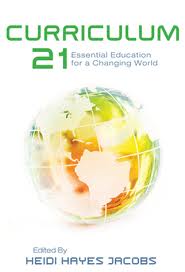 Heidi Hayes Jacobs (2010) is a strong voice for what has been deemed innovative curriculum in many US education circles ( See Jacobs Bio). Indeed, with Curriculum Integration, Jacobs delivers an accessible work for the public on the need for creating a 21st century curriculum. For instance, Jacobs states that “….our challenge is to match the needs of learners to a world that is changing with great rapidity” (p. 7), and that “Running schools and using curriculum on a constant replay button no longer works (p.8). Jacobs helps those in society with traditional and dominant dominant thought patterns around education start to imagine why what seems so natural may acctually be harmful to the one thing always professed as central, the learner. Jacobs goes on to give one of the best page and a half distillations of the history of of American Education I have read. I do have to admit that I loved reading and writing about (Baiylin (1960); Sizer (1964);Tyack (2000), Bowles and Gintis (1976); et al.) but the way Jacobs moves from Committee of Ten to Industrialization and beyond without creating any flashpoints for the ideology of curriculum in American society is laudable. With similar aptitude she wastes no time getting to the need for upgrading the curriculum and even tackles the structure of the school (pp.12-13). It is in this narrative that I become interested in Jacobs intentions for this book.
More import than filling in the public’s light historical knowledge of schooling in America is to relate the silent disaster our educational systems have become. Jacobs does this, again, without scare tactics or doom inspired rant. For instance, her 3 “myths that shape our operational visions of school” are simple and straightforward (pp. 14-16). In myth 1 Jacob’s explains that our insecurity in education comes from our lack of change when change is needed and not from implementing change. She weaves the story we all know well “we should not hurt our children with change” into an argument for more informed public involvement in education to “break the shackles that confine genuine progress” (p.15). She ends this section on myth 1 saying that some will want to hold on to 20th century modalities and all she asks is that they revise their mission statements to reflect this. “Be honest with the children” (p.15). In Myth 2 and three she tackles some huge issues in American education today. She deals with the present and growing divide in America around what it means to be educated. Stating that while American political ideology is polarizing with one group of Americans fiercely against “intellectuals” Jacobs, again gently calls the foundations of the US political system and its needs for educated, yet deliberative citizens into focus. This is important for the subaltern communities in the US as Jacobs again eases into statements like “we should be fearless about ideas and openly engage in discussion and debate about what should matter in the subject matter” (p.16). Jacobs edited work does not address the multicultural elements of this process until later in the book. Myth 3 is a Daniel Pink inspired address on learning spaces needing to cultivate collaboration and creativity for the 21st century.
Jacobs introduces many of the same well worn “softballs” that academicians, philosophers, and professionals have been tossing for many years in an accessible and almost folksy tone. This will prove important for those who want to start conversations on the communities on learning and systemic change in educational environments.
I will continue on Curriculum 21 in later posts.
Bailyn, B. (1960). Education in the forming of American society; needs and opportunities for study. Chapel Hill: Published for the Institute of Early American History and Culture at Williamsburg, Va., by the University of North Carolina Press.
Bowles, S., & Gintis, H. (1976). Schooling in capitalist America: educational reform and the contradictions of economic life. New York: Basic Books.
Jacobs, H. H. (2010). Curriculum 21: essential education for a changing world. Alexandria, VA: Association for Supervision and Curriculum Development.
Sizer, T. R. (1964). The age of the academies. New York: Bureau of Publications, Teachers College, Columbia University.
Tyack, D. B. (2000). The one best system: a history of American urban education. Cambridge, Mass. [u.a.: Harvard Univ. Press.
]]>