
“Democratic Living is not given in nature, like gold or water. It is a social construct, like a skyscraper, school playground, or new idea. Accordingly there can be no democracy without its builders, caretakers, and change agents….”-Walter Parker (2003)
“Imagining how events could be otherwise than they are is a hallmark freedom and power of human beings. Making social imagination work for us involves us in new concepts and principles, in new ways of using our minds to grasp complexities we do not yet comprehend. Thinking this way helps us construct new social realities both locally and globally. Social imagination is not merely for the sake of of academic knowing; it must include our feelings, and it must include our acting.”- D. Bob Gowin in Boulding (1998)
May the river you all navigate call for your best….always answer with passion.
]]>
Illich, I. (1973). Tools for conviviality. New York: Harper & Row.
]]>The symptoms of accelerated crisis are widely recognized. Multiple attempts have been made to explain them. I believe that this crisis is rooted in a major twofold experiment which has failed, and I claim that the resolution of the crisis begins with a recognition of the failure. For a hundred years we have tried to make machines work for men and to school men for life in their service. Now it turns out that machines do not “work” and that people cannot be schooled for a life at the service of machines. The hypothesis on which the experiment was built must now be discarded. The hypothesis was that machines can replace slaves. The evidence shows that, used for this purpose, machines enslave men. Neither a dictatorial proletariat nor a leisure mass can escape the dominion of constantly expanding industrial tools.
The crisis can be solved only if we learn to invert the present deep structure of tools; if we give people tools that guarantee their right to work with high, independent efficiency, thus simultaneously eliminating the need for either slaves or masters and enhancing each person’s range of freedom. People need new tools to work with rather than tools that “work” for them. They need technology to make the most of the energy and imagination each has, rather than more well−programmed energy slaves.
I believe that society must be reconstructed to enlarge the contribution of autonomous individuals and primary groups to the total effectiveness of a new system of production designed to satisfy the human needs which it also determines. In fact, the institutions of industrial society do just the opposite. As the power of machines increases, the role of persons more and more decreases to that of mere consumers……
I choose the term “conviviality” to designate the opposite of industrial productivity. I intend it to mean autonomous and creative intercourse among persons, and the intercourse of persons with their environment; and this in contrast with the conditioned response of persons to the demands made upon them by others, and by a man−made environment. I consider conviviality to be individual freedom realized in personal interdependence and, as such, an intrinsic ethical value. I believe that, in any society, as conviviality is reduced below a certain level, no amount of industrial productivity can effectively satisfy the needs it creates among society’s members…..
As citizens have new choices, new chances for learning, their willingness to seek leadership should increase. We may expect that they will experience more deeply both their own independence and their need for guidance. As they are liberated from manipulation by others, they should learn to profit from the discipline others have acquired in a lifetime. Deschooling education should increase — rather than stifle — the search for [people] with practical wisdom who would be willing to sustain the newcomer in his educational adventure. As masters of their art abandon the claim to be superior informants or skill models, their claim to superior wisdom will begin to ring true. –Illich (1970)

To Exhibit Learning
Exhibitions beautifully disrupt institutions and show deep learning. An exhibition, in short, is a public presentation of learning. Exhibitions are practiced at all levels of education and in all fields. A learner or group of learners publicly exhibit their understanding of knowledge territories and connect learning to relevant issues of today. This is important and hard work that shows the individual and group that learning does not only happen within the walls of an institution but is a matter for society in general. Inviting the public to view, question, comment, and participate in a learning community reveals, connects and networks learning communities. Exhibitions also decolonize the pedagogue. When educators open their process or teaching to the outside world they ensure an essential conversation to ensue on the import of the work they do. Whether you adhere to Ted Sizer and the Coalition of Essential Schools vision of exhibitions as assessment or just agree with performance assessment being public I have no doubt that you see the benefit of opening the learning process to communities outside of your institution, school, room…. in dynamic ways.

Enmesh our pedagogy with the world
Dynamism and the ability to imagine, collaborate, and co-design learning environments are hallmarks of effective pedagogues today. These are all skills that are not learned in the semester course on literacy or technology in education. Many of us face institutional constraints in our work in education and seek ways to open our learning communities. We work to collectivize, democratize, co-create and enable personal and group passions for flow in learning. Many of us have been, as a passionate educator once told me I would become prior to my first classroom experience, ” a coalition in your own classroom” (sub whatever you want to imagine to replace coalition in your situation). But this is not enough. Learning is an ecology that is interconnected and interdependent. We must share our communities work, we must exhibit, the whole ecology must weigh its social imagination into the mix….We need to show learning, failure and iteration and ask for feedback, connect and network our work on new levels…. we must enmesh our pedagogy with the world.
Open a human creation
Exhibitions open education to the world. In the process of preparing for public participation in learning the individual looks deeply at the connections they are making….the common good in their endeavor….their learning moves from 8-3, 12:30-1:30, Tuesday and Thursday to their heart. When you face the public you face your heart….Yes nerves flash signals and the body quivers upon the thought of being on stage, but your heart tells the story. For the young person in high school the story might be “what does it mean to go to school in the 21st century….what is ‘world history’ ‘literature’, ‘science’, ‘my life’…. For the pedagogue the story needs to be ” ‘what am I undertaking’, ‘what role do I have in society’, ‘who may look to me’, ‘how will I collaborate with the world’….”. As one who believes in the commons and in learning as ecology I want to see more than a transcript and degree from any institution from “masters” of pedagogy or any field. I want to see a heart beating, a passion for learning….something different from books and sites….a human creation.
Find a learning ecology
Join me in finding ways to open education. Exhibitions are just one of these ways. We who have decided to be pedagogues as part of our learning ecology will benefit from making the learning communities we work within visible. This networking will help other communities change, become dynamic, and change again to make learning dynamic, resilient, and ubiquitous.
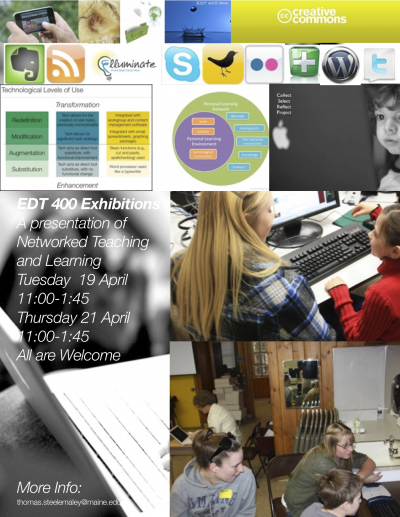
This week is exhibition week in one of the learning communities I work with
I look forward to being a part of this meaningful time.

A video and education reform’s 100 year failure
A timely video inspired by Michael Wesch came across my desk today and it comes at an interesting time in my thinking on education. The Future of Ed Reform? weaves a very short yet potent story about the realities so many of us face who seek to radically change the structure of education from “places of schooling” to “places of learning”.
I have written about critical education in many posts and realize that most of my ideation, design and praxis towards democratic education has met with the realities of institutions, schooling an societal structures around education and official knowledge. I would like to say I met these challenges and take the path I do now, knowing I stand on the shoulders of progressives and a hundred years of work from John Dewey, L. Thomas Hopkins et al., and their contemporaries James Beane, Micheal Apple, Deb Meir and so many others who are in the field not writing prolifically but fostering experiences and learning.
The Future of Ed Reform begs questions of reform and stasis in education. “If so many years of reform, (including some almost 100 years old that espouse the same reform we are seeking in education today) have failed why do we think it will work….this time.” A good question and one I had with a visionary leader and progressive educator in the field just yesterday: More on this in future posts.
The author of Future of Ed Reform is right to question these new “reforms” and their ability to succeed. The authors points at “the revolution failed” are right. The use of Dewey as an example is illustrative of the issues here. Dewey, Francis Parker, L. Thomas Hopkins et al. faced a backlash from an American society bent on order and standardization. Though their reform was brilliant and on the mark in many ways, school in the 20th century was an institution based on order and control just as it is today. Today as in the 20th century, linear schedules, corporate curricula, and the extra-curricularization of energy and interests still combine to hold firm what has been at the expense of what is. The School structure and its meanings are the issues of today just as they where a century ago.
Dewey did call for a revolution from schooling to learning, and espoused among so many brilliant ideas a call for deschooling on the grounds that control and order do little for learning. Dewey (1938) reflects,
Almost everyone has had occasion to look back upon his [and her] school days and wonder what has become of the knowledge he was supposed to have amassed during his [and her] years of schooling….but it was so segregated when it was acquired and hence is so disconnected from the rest of experience that it is not available under the actual conditions of life. (p.48)
We must reflect presently on the “reform” engines of today motoring throughschools and quietly accepting the structures imposed in what amounts to seeing learners and their communities as commodities and economies of scale, versus dynamic realities of human possibility. The author of The Future of Ed Reform? is calling out the realities of societal structures and the school not the reform which may have similarity to our 100 year past.
To Create, To Design
It is no mystery to many that I favor the design of new learning Ecologies that leverage much of what Dewey et.al espoused and practiced in the fields of experiential and democratic education. I have also focused my work on the networking of blended learning ecologies. A combination of Illich’s learning webs, the mesh ideas of OLPC and my roots in experiential and mobile learning in the big outside. This design like so many is at risk when placed against the onslaught of stasis in education. No Softballs here, we have heard them in detail. Yet I find myself asking are we ready for a networked learning ecology? Is society? What will it take?
So anthropologists, critical educators, deschoolers, unschoolers, reformers, what will make your vision work? Are you part of a revolution? If so why, and will that revolution be enough force to break the dam of traditional control and order schooling to create or recreate places of learning for society? I am interested in hearing your voice and working with you.
]]>
From: Yong Zhao » Blog Archive » A Nation At Risk: Edited by Yong Zhao. (n.d.). Yong Zhao. Retrieved March 11, 2011, from http://zhaolearning.com/2011/03/10/a-nation-at-risk-edited-by-yong-zhao/
Indicators of the Risk
The educational dimensions of the risk before us have been amply documented in materials read by this editor. For example:
- For
the first time, research shows American creativity is declining. Since
1990, Americans’ creativity scores have been on the decline
significantly and most seriously among young children (from kindergarten
through sixth grade). - As
a result of No Child Left Behind (NCLB), a significant number of
schools in America have narrowed their curriculum by cutting arts,
music, physical education, social studies, science, recess, or lunch.
“Forty-four percent of all districts nationwide have added time for
English language arts and/or math, at the expense of social studies,
science, art and music, physical education, recess, or lunch.” - Meanwhile, our competitors such as China and Singapore
have been decreasing their instructional time for math and increasing
time for creativity, critical thinking, arts, physical education. For
example, since 1999 China has decreased total instructional hours by 380
for grades 1 through 6, reduced math instruction by 140 hours and added
156 instructional hours for physical education. - Unethical
and dishonest behaviors have become rampant in American education.
Teachers, school administrators, and students have been forced to engage
in all sorts of cheating to raise test scores and state governments
lower standards to avoid penalties. - America
spends $1.1 billion dollars per year testing their children under NCLB
while many schools have to cut short instructional hours and or lay off
teachers due to budget cuts. - In
2004–2005, Wisconsin students spent a total of about 1.4 million hours
taking state tests; with full implementation of NCLB testing, that
number will more than double, to 2.9 million. These figures do not
include the time spent distributing and collecting materials, taking
practice tests, giving instructions, and addressing other logistics of
testing. - American teachers’ morale has reached a crisis level. Over a quarter of teachers leave the profession within the first three years and nearly half leave within the first five.
- Teacher unions, the last organized line of defense for public education, are being threatened across the nation.
- Yet,
the governments continue to impose policies that connect teacher
evaluation with student test scores although research has clearly shown
that such policies do not improve student learning, even measured by
test scores. - American education has become a nationalized standardized
education system. Locally democratically elected school boards have been
rendered bureaucratic assistants of the state and federal government to
enforce implementation of state and federal mandates rather than
guarding the education of their children. - Less
than 20% of American students are enrolled in a foreign language course
while all Chinese students are required to study a foreign language
beginning from third grade at the latest. - Only 11 percent of twelfth graders nationwide demonstrated proficiency in U.S. history.
- More
than 80 percent of New York City eighth graders did not meet the state
standards in social studies in 2004. Moreover, the number of students
meeting the social studies standards has decreased by almost 20
percentage points since 2002. - 25
percent of college-bound high school students could not name the ocean
between California and Asia. 80 percent of young Americans (ages 18 to
24) did not know that India is the world’s largest democracy; 37 percent
could not locate China on a map of Asia and the Middle East. - The
average number of languages spoken by American business executives is
1.5, compared with an average of 3.9 languages spoken by business
executives in the Netherlands. - Business
and military leaders complain about the lack of international and cross
cultural skills of American graduates. “A 2002 survey of large U.S.
corporations found that nearly 30 percent of the companies believed they
had failed to exploit fully their international business opportunities
due to insufficient personnel with international skills. The
consequences of insufficient culturally competent workers, as identified
by the firms, included: missed marketing or business opportunities;
failure to recognize important shifts in host country policies toward
foreign-owned corporations; failure to anticipate the needs of
international customers; and failure to take full advantage of expertise
available or technological advances occurring abroad. Almost 80 percent
of the business leaders surveyed expected their overall business to
increase notably if they had more internationally competent employees on
staff.”
Time to Deschool
Powered by ScribeFire.
]]>
Would you listen?
A Note to an amazing group of teachers and learners….
I have been encouraged by our meetings in EDT400 this spring semester. But today you showed the desire to innovate in clear terms. You saw that learning-not teaching is what education is all about. The barriers to seeing and acting to move learning from irrelevance into a networked, purposeful, fun, and useful….environment for the young and old are real. Your candor and imaging today gave me cause to be hopeful. Your passions will guide you well as teachers and learners. I also saw many ah ha moments today! If machines can replace teachers, they will. Who will be replaced…..
Much for us to discuss…..networks in learning, opening the school, mLearning revolutions, design based learning…..
Thank you all.
]]>
Can you have connectivism without computers….could you treat the classroom/learning center and face to face “time” like a connectivist hub? If so, where would the student go to find, validate, leverage, analyze and synthesize information in that place? Could she problem solve and communicate in an unrestricted way to learn freely? ….”
Connectivism is about networks of learning that connect individuals with the world. This may be messy and no, it most likely does not fit neatly into the institution of “schooling”. That said, connectivist praxis can happen wherever we choose to embrace the learning theory and experience. We need to work to find ways to learning that are meaningful and stop squabbling over old institutional theories that fit neatly into our outdated vision of the school.
As Sawyer (2006) states,
Educated graduates need a deep conceptual understanding of complex concepts, and the ability to work with them creatively to generate new ideas, new theories….and new knowledge (p.2).
We need to focus on active connections, networks, and our ability to revision the places education happens.
Sawyer, R. K. (2006). The Cambridge handbook of the learning sciences. Cambridge: Cambridge University Press.
This post was inspired by a student….and new teacher in the field
]]>The real question is why we need a LMS to begin with….
]]>
In a welcomed twist to our review of educational theory on Tuesday a few folks in section 2 of EDT400 sought to deliberate on Behaviorism and specifically the issue of grading with letters and numbers as reward and punishment. Reflections on the import of grading centered on “not knowing where I was, or what my learning meant” because of assessment systems that “looked and felt” “different”. The use of “check marks” in elementary school (lasting effects!) and a high school experience at one of the most innovative schools in Maine if not New England, where letter grades and rank are not used in favor of more authentic assessment modes (see below).
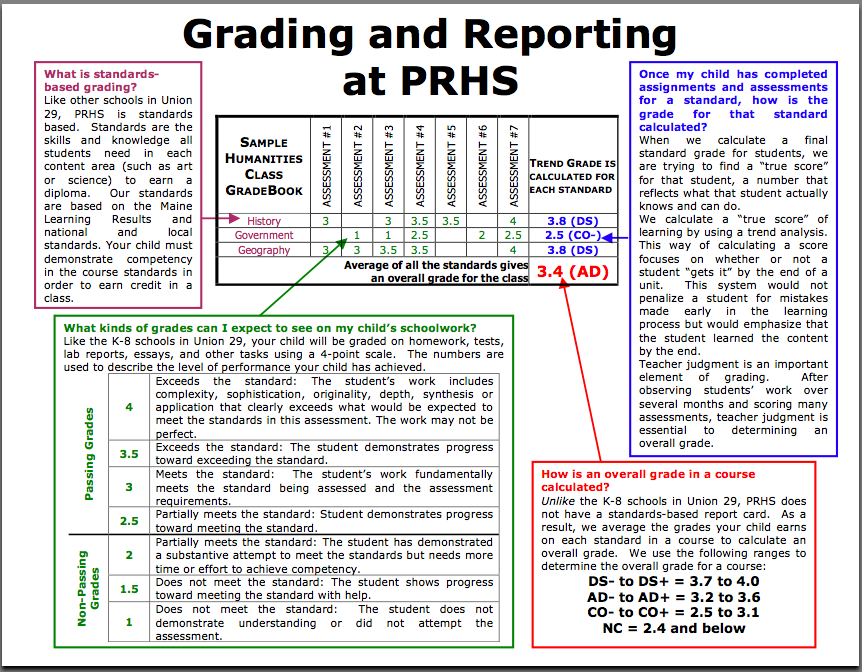
Why we learn is as important as what we learn when attempting to understand educational theory, and underlying issues with teaching and learning. To this end I am very interested in this discussion. EDT 400: can you receive an A on something (a paper or in a course) and still fail? If so what does this mean for networked learning in a blended VLE such as ours? How should you be assessed? Why are you involved in the learning community? These are well worn questions and important for a course like ours to deliberate on. We seek to imagine new ways of learning at the same time old ways of learning are dominant and this is difficult. You are involved in important work.
So for those of you who are attending or participating in any learning episode for a good grade; is this all you need to advance? What do you really want out of learning? What if I were to give everyone in EDT 400 an A now? What would happen? Let me know if this is what the community wants, my ears and eyes are open.
Thursday’s Meeting
A few more considerations for our meeting on Thursday: How do the following TPCK and SAMR models square up with Constructivism and Connectivism?
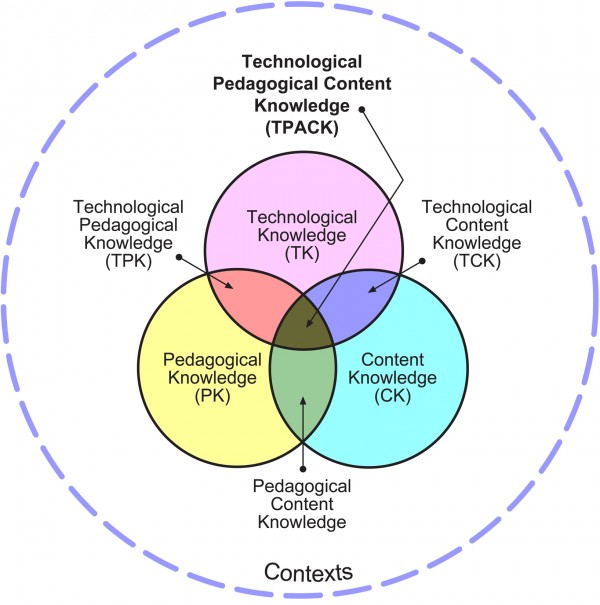
TPCK – Technological Pedagogical Content Knowledge – TPCK. (n.d.). Retrieved February 02, 2011, from http://www.tpck.org/
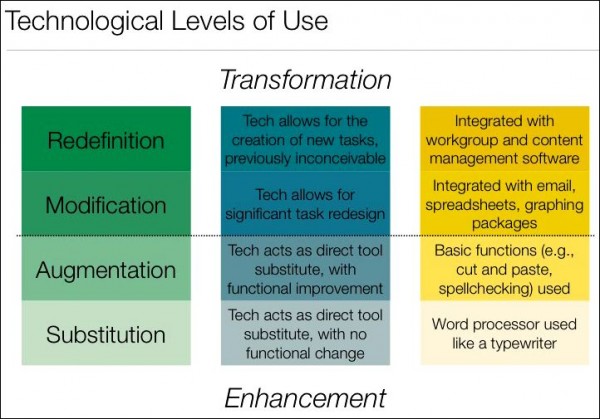
Ruben R. Puentedura’s Weblog: As We May Teach: Educational Technology, From Theory Into Practice. (n.d.). Hippasus. Retrieved February 02, 2011, from http://www.hippasus.com/rrpweblog/archives/000025.html
]]>