You know when you are amidst something special, when the feeling of that float plane adventure comes back. When I talk and collaborate with my Wife and Charlie Richardson, Shoshana Zuboff, Jake Maxmin, Rob Greco, Grant Lichtman, Bo Adams, Brett Jacobsen and Scott Looney, Shane Krukowski, Jim Groom, Audrey Waters…. I get that feeling of flying out of Davidof Lake again. When I watch Michael Wesch discuss becoming Knowledge-Able vs Knowledgable, I get that feeling again.
What binds us all is a feeling and belief that the educational community to come is not only possible but underway. A belief in the process, driven by a strong understanding of why the field of education needs change, a penchant for designing interventions that will Mutate education, and the ability to iterate as needed to see a pathway to our goals.
Over the coming months, I will write a series of posts on my current project: GEMS World Academy Chicago. As CIO and Director of Academic Technology I am supporting four educational innovations to scale in PK-12 1:
SELF DIRECTED LEARNING
For students to become global citizens they must think and act as self directed learners. From the earliest years we inspire our students to ask more questions than they answer, follow their interests and passions and act as part of a community to identify and work towards solving real world problems. As the years progress our programs support self directed and interdisciplinary/transdisciplinary project based learning which start with student interests and questions about the world. In groups and as individuals students find relevant problems, ask ever more complex questions, work with mixed research methods (both in the city and online), analyze, synthesize and reflect on their work through portfolio’s of understanding and action. Students share their work with the world through service and exhibition.
LANDSCAPE AS LEARNING: A NEW VIEW OF MOBILE LEARNING
For students to become global citizens they must explore, ask questions, observe, empathize and act in the world without borders. During the year a minimum of four hours each week is dedicated to learning outside of the school building in local landscapes. Through a pioneering landscape as learning initiative, students closely engage their local community through field study based mobile learning labs. Through multimedia data collection using iPads and other tools, students experience the sensory aspects of their community while learning about systems, empathizing with others and contributing through engaging projects and meaningful service. This learning in the real world, looks and feels like the real world thus creating the conditions for a fundamental expansion of where and how learning happens. We believe the disposition of seeing and studying the world as it is and working on how it might be otherwise, is at the root of global citizenship, community based learning, internship and entrepreneurial studies.
CONNECTED AND BLENDED LEARNING
For students to become global citizens they need to connect and collaborate across the world in rich and purposeful experiences. Our connected and blended learning program provides a landscape where the internet supports and enhances interactions in real time and anytime. We encourage and support our teachers to engage in a wide array of connected and blended learning with their classes. Our connected and blended learning innovation allows for:
● Co-learning and creation across continents, oceans and cultures giving our students a direct and experiential way of using the internet as a mediating force in learning.
● An extensive digital documentation system allows for self, peer, teacher, parent and community assessment for learning.
● An ePortfolio platform allows students to collect, select, reflect, and project on their learning.
● Networks to connect, aggregate, remix, repurpose and feed forward work and the work of the world.
A SCHOOL AS A HUB OF CONNECTIONS
For students to become global citizens they need a school that promotes self organization, inquiry innovation, and futures thinking. Our physical school has interactive whiteboards throughout the building, on every floor, in hallways and in classrooms along with networked computer stations, hydroponic plant labs, weather stations and much more. At any moment a few students or a whole class can connect with peers or mentors from around the world to discover and learn together in real time throughout the day. Using these tools students also can connect the data from their projects in growing sustainable food systems, tracking weather and climate patterns, or how play effects our learning to a global consortia of other individuals, schools and organizations. Through these interactions students are encouraged to understand how their school functions as part of a global “internet of things”.
In each of these innovations I am struck by the intensity and passion displayed in the praxis of the educators I am working with right now. Their embrace of something very different from any other school has me on edge with excitement and possibility. As I look out from the “floatplane” this time, its not old growth forest and pristine oceanscapes I see, but rather the landscape of three quarters of humanity–the city. What canyon we find to fly, and ocean we decide to traverse, is our to decide. I hope you find the story inspiring.
A [person] who carries a cat by the tail learns something he can learn no other way-Twain
Without question, experiential learning enhances scholastic learning….this type of learning builds confidence, encourages risk taking, reduces the fear of failure, gives oxygen to collaboration, nurtures imagination, promotes problem solving, allows reverie, and grows a taproot from which scholastic learning flowers”.- MacKenzie
1 My acknowledgement to the foundational design and praxis from (Steele-Maley, Richardson, C. 2012) The Bridge Year at Kieve-Wavus, Project Foundry Schools, SuperFlux….et al.
]]>In that class and many others, I have tried to guide deliberation with big questions about humans, design and practice– not offering technology as some cut away all powerful and intervening point of its own. Technological tools in the hands of humans can be used to innovate, expand and open our social economic and environmental frontier. An iPad used by a second grader to answer the questions she has co-developed by collecting participatory data for a global & multi-sited project on water quality is powerful. Crowd sourcing people (student partners, mentors, etc. . . ) to support the learning process via the vast landscape of the internet is powerful. Focus on the action, the social construct, the learning involved, not the structures of “school” or “positions” and you have the aims of education alight and aloft–in practice. That said, technology today is being used to replicate the 20thcentury models of education anew. The replacement of textbooks “online”, the “flipping” of didactic instruction to the web and the adaptive learning wave seem to inflame institutional immunity to change, not reflect what is needed in our rapidly changing world. I will admit that technology, used to replicate 20th century teaching challenges the salience of teaching–a very stark realization. Enter Sugata.
Sugata challenges, inspires and infuriates the educational community. He is an educator and a futurist who, through his design research projects, has created a series of design fictions, described by Bruce Sterling as “the deliberate use of diegetic prototypes to suspend disbelief about change.”
Take a look at his TED Wish again:
”]Sugata is not advocating that technology replace humans, rather that humans use technology to envision, design and practice within new ecologies of learning. He posits that the teacher’s role today is to “set the learning in motion” and that “educational self organization Its not about making learning happen its about letting it happen.” He also asks a wondrous question in the Ted talk…..do we “want to be spare parts for a massive supercomputer in the future?”. Sugata is challenging us to a global deliberation, to join a global research project, to observe, question, experiment, network and associate. To me, this is the way human agency is embedded in technology and innovation. Deliberation, decision making, prototyping, iteration all involve the designer and end user to be involved as active and connected agents in learning–if not this, what is the aim of education?
Sugata recently headlined The Oppi Festival with a host of others I respect dearly including Yong Zhao, Tony Wagner and Doug Belshaw. According to this post, Sugata continues to ruffle feathers in certain circles of education while according to this post he continues to inspire. Sugata is doing exactly what he set out to do, and he is doing it well.
Are you engaging with Sugata in his research, incorporating his ideas into your design and practice as an educator? I would love for you to leave information on your project, commentary and links.
]]>

After a core design of what Global Civ was to be , I sought a next generation developer. That young person would give feedback and create for what was then a new organization The Institute for Global Civic Culture. Instead of the informal inputs I thought would occur with young people, I was incredibly fortunate that 15 year old Jake Maxmin entered the design process directly and became a full time student co-founder and designer. Three years later, Jake is off to Georgetown and I sense a major chapter in my research and praxis about to iterate. In this first post on Global Civ I offer a few “views” from the eLearning Nexus (a Mahara instance that served as a learning portal for the project).
The North American Experience Syllabus From the syllabus:
“In this project we will learn about place through North American culture and history. By exploring the relationship between landscape and the North American Identity we will seek to understand how different peoples have encountered, experienced, and represented North America from 10,000 years ago to contemporary times. How have the experiences of North American shaped the places in North America? How has the North American’s understanding of society, environment, and economy shaped a sense of who they are and how they impact an ecoregion?”
Global Civ Fieldwork (An Example) Global Civ experimented with Mobile “fieldwork” based in part on university anthropology fieldwork forms applied to specific settings.
Global Civ 21st Century Literacies (A Student Perspective) This work was based on the Institute for Global Civic Cultures Learning Ecology Framework created in the original design,
“an approach to learning embodied in an integrated and integrative curricular core will be intensified through eLearning. This nexus between highly student centric curriculum and eLearning will provide the learning community with a new learning ecology. This ecology will allow young people and their communities both local and global to connect in authentic, effective and exciting ways.”
“Project based and collaboration rich software such as the Mahara, 37 signals, and Elluminate will enable our learning spaces to have a flexible web 2.0 enabled system that work within Global Civ’s many project based learning endeavors. Throughout the first year of operations and then on a continual basis, the whole community of Global Civ will find and validate new eLearning tools for the proliferation of our learning spaces. This integrative process will allow for young people to use and develop the technologies they see as integral to their learning.
“Global Civ’s learning ecology will provide the frameworks necessary to utilize mLearning in expansive ways. Mobile Learning using, iPhones, netbooks, and other portable tools will offer the learning community chances to take learning in highly dynamic situations to a new level.”
]]>
]]>
More on TheNewHive
The New Hive from TheNewHive on Vimeo.
]]>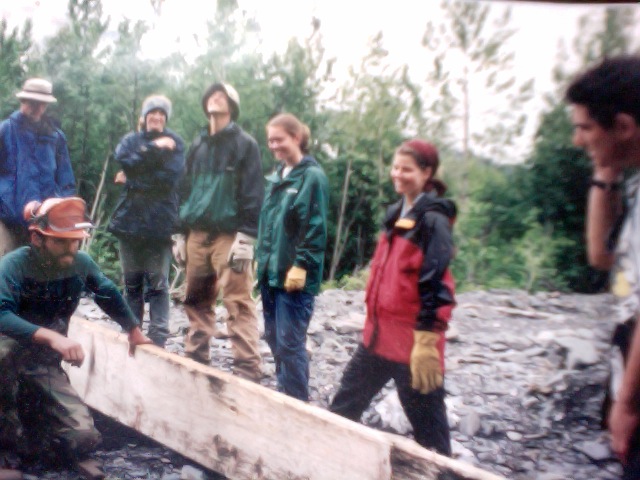
Found this picture today of a conservation work crew of amazing young people I Co-Led with my wife in Alaska. Everyone was quite uncertain about our pending 1500 foot assent in 1 mile with this 20 foot plank (to fix a bridge damaged in spring melt)….Que pep talk.
24/7 with young people in the back country of AK=ubiquitous learning.
]]>Listen closely to the “lesson I want to get across” at minute 6:31….”There is no opting out of new media….it changes a society as a whole….media mediates relationships….the whole structure of society can change….we are on a razor’s edge between hopeful possibilities and more ominous futures….”
At min 8:14 Wesch describes what we need people to “be” to make our networked mediated culture work, and the barriers we are facing in schools. Wesch is right on. Corporate curriculum, schedules, bells, borders, and “teaching/classroom management” are easily assisted by technology. Yet to open learning and deschool our educational system represents the hopeful possibilities Wesch imagines and has acted on. What we accept from industrial schooling, how we proceed in our educational endeavors, and what we do, facilitate, witness, and promote in our actions in education mean so much to learners of today and the interconnected and interdependent systems we are all a part of.
Powered by ScribeFire.
]]>
Greco
We need them….dedicated and passionate teachers and learners who see learning as a design that the learner moves, shapes and feeds forward as positive action in our world….educational communities need them, those with social imagination….experts, yes experts. The more I get to know Rob Greco the more he reminds me of Illich’s (1970) “people with special educational competence”.
Three types of special educational competence should, in fact, be distinguished: one to create and operate the kinds of educational exchanges or networks outlined here; another to guide students and parents in the use of these networks; and a third to act as primus inter pares in undertaking difficult intellectual exploratory journeys….To design and operate the networks I have been describing would not require many people, but it would require people with the most profound understanding of education and administration, in a perspective quite different from and even opposed to that of schools.
Greco lives his educational experiences with the learners in his communities….he sees the messiness in learning, breathes deep of the essence, and trusts in the human capacity for mutual aid….I witnessed the outcome of that journey in an Elluminate session on Tuesday. The middle level learners Rob guides worked as a community to exhibit what was important to them about learning and life. I was awestruck with joy and hope.
Blackall
Leigh continues to amaze me. After a brief blogging hiatus, he is right back with thought provoking work, feeding forward amazing resources and inspiring. His recent thoughts on “ubiquity” contribute much to the deschooling and networked learning conversation. Feeding forward Ian Hart’s (2001) Deschooling and the Web was welcomed reading this week.
Hine
Howard Rheingold’s bookmark quest for P2P learning networks brought me right back to Dougald Hine’s School of Everything page. I delved into his links on Free U, The Learning Exchange and the Young Foundation
Littky
If your not on the edge, you’re taking up to much space
I have read, watched and learned from Dennis for many years….I am more amazed than ever.
See
Big Picture Learning Profile
College Unbound
Much more….P2P Foundation Wiki Blog
]]>

A video and education reform’s 100 year failure
A timely video inspired by Michael Wesch came across my desk today and it comes at an interesting time in my thinking on education. The Future of Ed Reform? weaves a very short yet potent story about the realities so many of us face who seek to radically change the structure of education from “places of schooling” to “places of learning”.
I have written about critical education in many posts and realize that most of my ideation, design and praxis towards democratic education has met with the realities of institutions, schooling an societal structures around education and official knowledge. I would like to say I met these challenges and take the path I do now, knowing I stand on the shoulders of progressives and a hundred years of work from John Dewey, L. Thomas Hopkins et al., and their contemporaries James Beane, Micheal Apple, Deb Meir and so many others who are in the field not writing prolifically but fostering experiences and learning.
The Future of Ed Reform begs questions of reform and stasis in education. “If so many years of reform, (including some almost 100 years old that espouse the same reform we are seeking in education today) have failed why do we think it will work….this time.” A good question and one I had with a visionary leader and progressive educator in the field just yesterday: More on this in future posts.
The author of Future of Ed Reform is right to question these new “reforms” and their ability to succeed. The authors points at “the revolution failed” are right. The use of Dewey as an example is illustrative of the issues here. Dewey, Francis Parker, L. Thomas Hopkins et al. faced a backlash from an American society bent on order and standardization. Though their reform was brilliant and on the mark in many ways, school in the 20th century was an institution based on order and control just as it is today. Today as in the 20th century, linear schedules, corporate curricula, and the extra-curricularization of energy and interests still combine to hold firm what has been at the expense of what is. The School structure and its meanings are the issues of today just as they where a century ago.
Dewey did call for a revolution from schooling to learning, and espoused among so many brilliant ideas a call for deschooling on the grounds that control and order do little for learning. Dewey (1938) reflects,
Almost everyone has had occasion to look back upon his [and her] school days and wonder what has become of the knowledge he was supposed to have amassed during his [and her] years of schooling….but it was so segregated when it was acquired and hence is so disconnected from the rest of experience that it is not available under the actual conditions of life. (p.48)
We must reflect presently on the “reform” engines of today motoring throughschools and quietly accepting the structures imposed in what amounts to seeing learners and their communities as commodities and economies of scale, versus dynamic realities of human possibility. The author of The Future of Ed Reform? is calling out the realities of societal structures and the school not the reform which may have similarity to our 100 year past.
To Create, To Design
It is no mystery to many that I favor the design of new learning Ecologies that leverage much of what Dewey et.al espoused and practiced in the fields of experiential and democratic education. I have also focused my work on the networking of blended learning ecologies. A combination of Illich’s learning webs, the mesh ideas of OLPC and my roots in experiential and mobile learning in the big outside. This design like so many is at risk when placed against the onslaught of stasis in education. No Softballs here, we have heard them in detail. Yet I find myself asking are we ready for a networked learning ecology? Is society? What will it take?
So anthropologists, critical educators, deschoolers, unschoolers, reformers, what will make your vision work? Are you part of a revolution? If so why, and will that revolution be enough force to break the dam of traditional control and order schooling to create or recreate places of learning for society? I am interested in hearing your voice and working with you.
]]>
From: Yong Zhao » Blog Archive » A Nation At Risk: Edited by Yong Zhao. (n.d.). Yong Zhao. Retrieved March 11, 2011, from http://zhaolearning.com/2011/03/10/a-nation-at-risk-edited-by-yong-zhao/
Indicators of the Risk
The educational dimensions of the risk before us have been amply documented in materials read by this editor. For example:
- For
the first time, research shows American creativity is declining. Since
1990, Americans’ creativity scores have been on the decline
significantly and most seriously among young children (from kindergarten
through sixth grade). - As
a result of No Child Left Behind (NCLB), a significant number of
schools in America have narrowed their curriculum by cutting arts,
music, physical education, social studies, science, recess, or lunch.
“Forty-four percent of all districts nationwide have added time for
English language arts and/or math, at the expense of social studies,
science, art and music, physical education, recess, or lunch.” - Meanwhile, our competitors such as China and Singapore
have been decreasing their instructional time for math and increasing
time for creativity, critical thinking, arts, physical education. For
example, since 1999 China has decreased total instructional hours by 380
for grades 1 through 6, reduced math instruction by 140 hours and added
156 instructional hours for physical education. - Unethical
and dishonest behaviors have become rampant in American education.
Teachers, school administrators, and students have been forced to engage
in all sorts of cheating to raise test scores and state governments
lower standards to avoid penalties. - America
spends $1.1 billion dollars per year testing their children under NCLB
while many schools have to cut short instructional hours and or lay off
teachers due to budget cuts. - In
2004–2005, Wisconsin students spent a total of about 1.4 million hours
taking state tests; with full implementation of NCLB testing, that
number will more than double, to 2.9 million. These figures do not
include the time spent distributing and collecting materials, taking
practice tests, giving instructions, and addressing other logistics of
testing. - American teachers’ morale has reached a crisis level. Over a quarter of teachers leave the profession within the first three years and nearly half leave within the first five.
- Teacher unions, the last organized line of defense for public education, are being threatened across the nation.
- Yet,
the governments continue to impose policies that connect teacher
evaluation with student test scores although research has clearly shown
that such policies do not improve student learning, even measured by
test scores. - American education has become a nationalized standardized
education system. Locally democratically elected school boards have been
rendered bureaucratic assistants of the state and federal government to
enforce implementation of state and federal mandates rather than
guarding the education of their children. - Less
than 20% of American students are enrolled in a foreign language course
while all Chinese students are required to study a foreign language
beginning from third grade at the latest. - Only 11 percent of twelfth graders nationwide demonstrated proficiency in U.S. history.
- More
than 80 percent of New York City eighth graders did not meet the state
standards in social studies in 2004. Moreover, the number of students
meeting the social studies standards has decreased by almost 20
percentage points since 2002. - 25
percent of college-bound high school students could not name the ocean
between California and Asia. 80 percent of young Americans (ages 18 to
24) did not know that India is the world’s largest democracy; 37 percent
could not locate China on a map of Asia and the Middle East. - The
average number of languages spoken by American business executives is
1.5, compared with an average of 3.9 languages spoken by business
executives in the Netherlands. - Business
and military leaders complain about the lack of international and cross
cultural skills of American graduates. “A 2002 survey of large U.S.
corporations found that nearly 30 percent of the companies believed they
had failed to exploit fully their international business opportunities
due to insufficient personnel with international skills. The
consequences of insufficient culturally competent workers, as identified
by the firms, included: missed marketing or business opportunities;
failure to recognize important shifts in host country policies toward
foreign-owned corporations; failure to anticipate the needs of
international customers; and failure to take full advantage of expertise
available or technological advances occurring abroad. Almost 80 percent
of the business leaders surveyed expected their overall business to
increase notably if they had more internationally competent employees on
staff.”
Time to Deschool
Powered by ScribeFire.
]]>